

Thirsty Hummingbirds
Air Date: Week of February 27, 2026
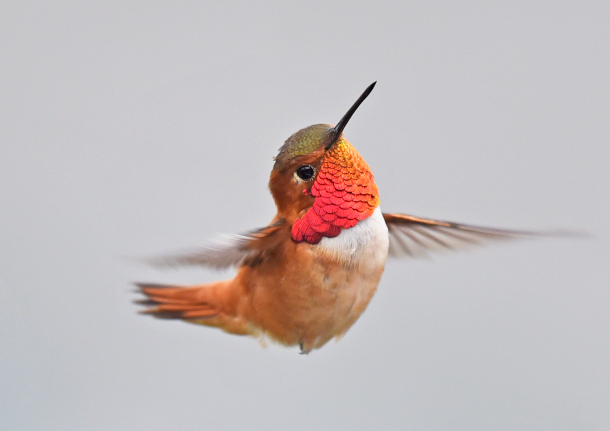
Rufous Hummingbirds, when they travel north after a hot winter in Mexico or Central America, will be looking for ways to satiate their thirst, making it a good time to invest in a bird feeder. (Photo: VJAnderson, Wikimedia Commons, CC BY-SA 4.0)
Hummingbirds are migrating north after a hot, dry winter in sunny Mexico, Central America or the Caribbean. And they’re ready for a drink. BirdNote®’s Mary McCann describes how you can help these thirsty birds by hanging a hummingbird feeder filled with the right kind of nectar.
Transcript
BELTRAN: The Caribbean is a wintertime home to many migrating birds that summer in North America, including hummingbirds. Here’s Mary McCann with today’s BirdNote®.
BirdNote®
Thirsty Hummingbirds
Written by Frances Wood
[Whirring and call of Rufous Hummingbird]
Here they come! Rufous Hummingbirds, Ruby-throats, and others are migrating north after a hot, dry winter in sunny Mexico or Central America. And they’re ready for a drink.
[Whirring and call of Rufous Hummingbird]
Hummingbirds need to consume several times their body weight each day, so they're looking for flowering plants to quench that mighty thirst. If a whirring puffball is hovering at your window, consider becoming a hummingbird bartender.
To help feed them, select a hummingbird feeder that you can easily clean on the inside, and one that has plenty of red to attract the birds. Then fill it with sugar water made by dissolving one part sugar in four parts water. No honey or sugar substitutes allowed. And please — no red food coloring.
[Call of the Rufous Hummingbird]
There’s no need to feel guilty that feeding hummers will lure them away from their natural sources of nourishment. The birds will continue to consume a healthy balance of plant nectar, small insects, and sap.
So set out a feeder, and before long, you may be hearing a hummingbird hovering around your watering hole.
[Whirring and call of Rufous Hummingbird]
You can learn a lot more about hummingbirds — and what attracts them. Begin at our website, BirdNote.org. I'm Mary McCann.
###
Senior Producer: Mark Bramhill
Producer: Sam Johnson
Managing Editor: Jazzi Johnson
Content Director: Jonese Franklin
Whirring, call and “J display” of the Rufous Hummingbird #109124, provided by The Macaulay Library of Natural Sounds at the Cornell Lab of Ornithology, Ithaca, New York. Sound Recordist: G.A. Keller.
BirdNote's theme music was composed and played by Nancy Rumbel and produced by John Kessler.
© 2016 Tune In to Nature.org March 2013/2016/2022/2025 Narrator: Mary McCann
ID# 033005RUHU hummingbird-06-2013-03-24 hummingbird-06
BELTRAN: For pictures, zip on over to the Living on Earth website, loe dot org.
Links
Living on Earth wants to hear from you!
Living on Earth
62 Calef Highway, Suite 212
Lee, NH 03861
Telephone: 617-287-4121
E-mail: comments@loe.org
Newsletter [Click here]
Donate to Living on Earth!
Living on Earth is an independent media program and relies entirely on contributions from listeners and institutions supporting public service. Please donate now to preserve an independent environmental voice.
NewsletterLiving on Earth offers a weekly delivery of the show's rundown to your mailbox. Sign up for our newsletter today!
 Sailors For The Sea: Be the change you want to sea.
 The Grantham Foundation for the Protection of the Environment: Committed to protecting and improving the health of the global environment.
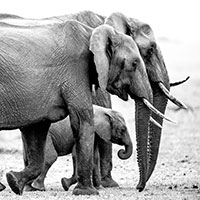 Contribute to Living on Earth and receive, as our gift to you, an archival print of one of Mark Seth Lender's extraordinary wildlife photographs. Follow the link to see Mark's current collection of photographs.
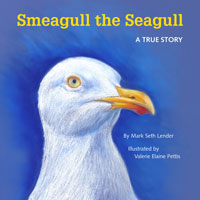 Buy a signed copy of Mark Seth Lender's book Smeagull the Seagull & support Living on Earth
© Copyright World Media Foundation. All Rights Reserved
Home | Contact | RSS | Donate | Newsletter