

Gardening for Special Needs
Air Date: Week of January 23, 2026
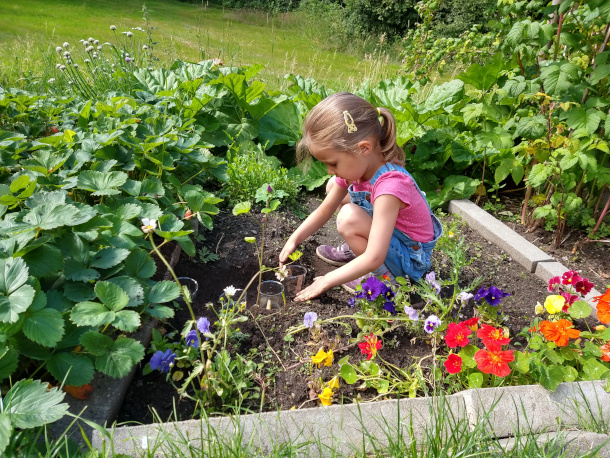
Gardening can help children regulate emotional health as well as learn mindfulness and resilience. (Photo: Elicarrera, Wikimedia Commons, CC BY SA 4.0)
For people with developmental or physical disabilities, growing plants in a garden may offer personal growth opportunities that unlock new possibilities outside of the garden too. This kind of transformation is something avid gardener Jill Mays has seen again and again in her work with disabled children and adults, and she speaks with Host Paloma Beltran about her book Nurturing Nature: A Guide to Gardening for Special Needs.
Transcript
CURWOOD: It’s Living on Earth, I’m Steve Curwood.
BELTRAN: And I’m Paloma Beltran.
In the late 1800s the British garden designer, writer and artist Gertrude Jekyll wrote: “A garden is a grand teacher... above all it teaches entire trust.” And for people with developmental or physical disabilities, growing plants in a garden may offer personal growth opportunities that unlock new possibilities outside of the garden too. This kind of transformation is something avid gardener Jill Mays of Cape Cod, Massachusetts has seen again and again in her work with disabled children and adults. Jill is an occupational therapist by training, and several years ago, she combined her interests and began to volunteer with the Truro Community Children’s Garden. Her book, Nurturing Nature: A Guide to Gardening for Special Needs , is relevant to people of all ages and abilities. She’s worked with people who have physical disabilities as well as those on the autism spectrum. Jill Mays, welcome to Living on Earth!
MAYS: Oh, thank you so much for having me.
BELTRAN: So Jill, you run a weekly gardening group for adults with disabilities. What is it about gardening that is so beneficial to this population?
MAYS: Well, the garden offers a smorgasbord of sensory input. You know, obviously visual, but then there's the smelling and hearing things, and then the moving around, and all of those things are very helpful and impactful to help engage this population. We have, like, millions and billions of input coming into our brain all the time, and we need filters to be able to figure out what to pay attention to and not to. And some people don't have effective filters in terms of being able to say, I can pay attention to this and not pay attention to that. And so a lot of people have hypersensitivities to touch. Others have hypersensitivities to sound. Even visual hypersensitivities can happen, where they have difficulty processing certain kinds of lights or whatever make them uncomfortable. And then there's people who, you know, have the whole ball of wax, so to speak, and you know, they're really in a very difficult state.
BELTRAN: How does participating in gardening mitigate that discomfort?
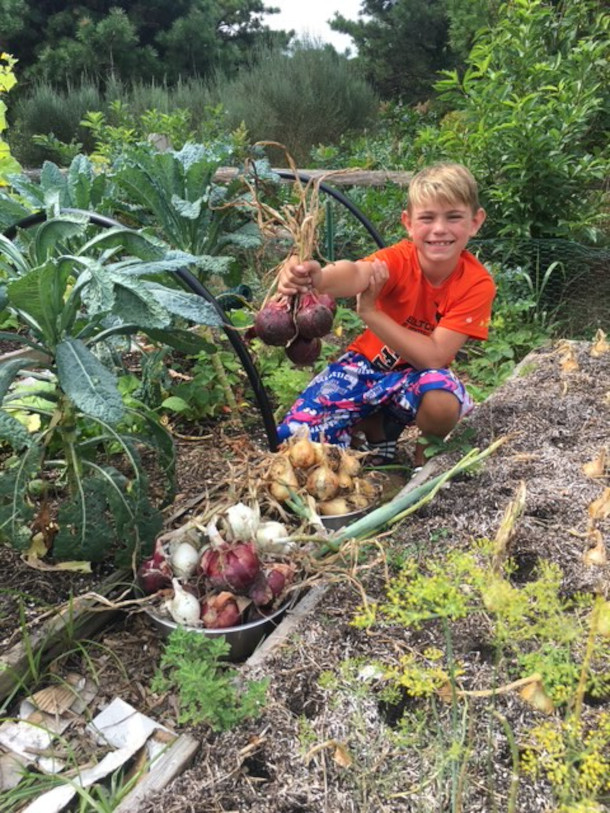
Pictured above is Jill Mays' grandson, holding onions in the garden. (Photo: Jill Mays)
MAYS: So for instance, after we have a welcoming and introductions where we're facilitating some socialization, we do a walk through an edible garden, an edible landscape. And along the way, we are looking at things and talking about our observations. And then we, there's always mint and lemon balm and things that I pull up and let them smell. And what that does is it activates the olfactory system. They love to look at the butterflies, because you can look at the details, and then they fly around. And so you're really activating the visual system in near point and then scanning. And then we always have a task to do. Usually it's weeding, and a lot of times they begin with, oh no, no, I don't want to touch the dirt, and I can't do that. And I'll say, I understand. All you need to do is five times, 12345, yay. You did a great job. The next time, it's 10 times. And so we begin to build resilience. And the other thing is, a lot of the people who are on the spectrum have a lot of hypersensitivities, especially to touch. And when they're in the garden, they're able to tolerate that, either by I, they have gloves, or I help explain to them that they're absolutely able to go wash their hands immediately. And so that's one aspect, is that they begin to tolerate in that respect, but also, because there's so much other sensory things, stimuli going on, it helps mitigate their focus on the discomfort of touch. And also, by being uncomfortable with touch, they have difficulty engaging with other people, because people are unpredictable, and they kind of want to stay in control, so the more we can help mediate that discomfort to touch, the more they're able to begin engaging socially.
BELTRAN: And can you tell us a story, Jill, you know, maybe, about a participant in the gardening group for whom you saw a significant change in their behavior over time?
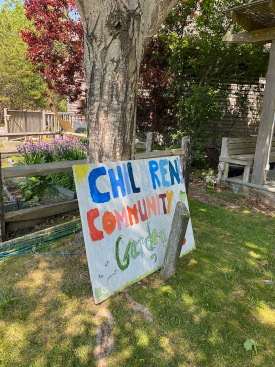
The Truro Children's Community Garden, a community project, was spearheaded by Sustainable C.A.P.E.* (Center for Agriculture, Preservation and Education) and the Truro library. Local businesses and volunteers helped build and run the group, which has been running since 2010. (Photo: Jill Mays)
MAYS: Absolutely. One young woman, very bright, on the spectrum, and has a lot of difficulty engaging with other people, so she would come to the garden group, and was very, very reticent to even, you know, always followed behind with, needed encouragement to follow our group on the tour, and was always like five or 10 feet behind. And over time, we were able to get her to be engaged in all of the tasks to the point where she became a helper. So in socialization, there's parallel work and play, where people are working alongside each other. So that was a first step. And over the course of a summer, at the end of each of our groups, we have a project that we do. And so things like potting up plants. And she was able to engage in cooperative work, helping another person and member of the group. So we went from very basic social skills to really much more engaged participation.
BELTRAN: So she really evolved in terms of teamwork, it sounds like.
MAYS: Teamwork, yeah, we actually end up with a good amount of teamwork, which is really lovely.
BELTRAN: So Jill, besides the anecdotal evidence, what does the science tell us about autism and gardening?
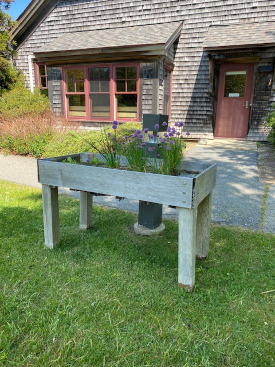
Wheelchairs can easily tuck under standing garden tables like the one pictured above, increasing gardening accessibility. (Photo: Jill Mays)
MAYS: So there have been several studies in which children participated in garden groups, and the studies have found that their emotional IQ, which includes self-awareness, self-regulation, motivation, empathy and social skills, that that improved and also social IQ, which is increased communication in this initiation and completion of tasks, and improvement in adaptive behaviors, that that also improved. So just participating for a six-to-eight-week program, they had really significant gains in those areas.
BELTRAN: And I understand that you were an occupational therapist. What are some of the experiences that inspired you to write a guide for gardening with special needs?
MAYS: Well, what I found when I started working in the garden, originally helping out with the children's garden that was in Truro, is that all of the skills that I worked at in the clinic and in classrooms were happening organically in the garden. So developing motor skills and the sensory processing, things that I talk about in terms of helping people engage more effectively, all of those things were happening in the garden.
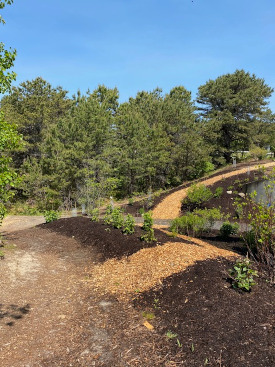
The Edible Landscape at the Truro MA Library. (Photo: Jill Mays)
And then I was invited to volunteer with a farmer in the school, in the Truro school, and what I saw was one particular event was with sixth graders. They were having to move compost from a big compost pile to the beds. You would think this would be like, oh my God. But you would think they were going to a rock concert. They were so pumped up, jumping up and down and happy. And it clicked for me that—so one of the huge things that I do in the clinic is working with children in terms of the filters that we've talked about, being able to help them with their sensory processing. And the first thing we need to do is something called heavy work, which activates nerves in the joints, and the nerves in the joints shoot up to the area of the brain that activates filters in the brain. The fancy word is inhibitory neurons, and so it's kind of like a Super Mario going [scratching sound], kind of erasing all of the extra input. So these are pre-adolescent, adolescent kids, and you know, they're like, climbing the wall. They're crazy with hormones and, you know, social anxiety and everything. And so what they did was—they were just really, really loving this. And this was a big aha moment for me, because I was like, wow, this gardening is so incredibly helpful for people to reduce anxiety and activate those filters.
BELTRAN: Yeah, nature really is healing and powerful. So if someone wanted to start a weekly gardening group in their own neighborhood, how might they make their gardening space more accessible for people with disabilities, like people on the spectrum, for example?
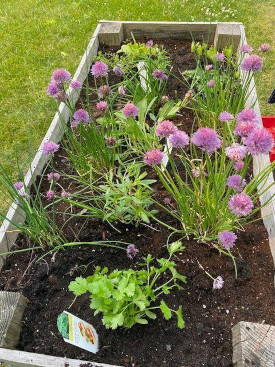
The Cape Abilities adult group cares for this herb box. (Photo: Jill Mays)
MAYS: Yes, there's certain considerations that you want to have for people who are on the spectrum and neurodiverse. The number one rule when you're forming a garden and you want to work with this population is first to make sure that it's a successful experience. That's number one. So number two is that you need to be flexible in the approach that you use with these people. So for instance, you want to take a look at what their abilities are and sort of match the activities and the tasks to what their abilities are, what their capabilities are. So for instance, let's take weeding. If an individual has a little bit of trouble, like discerning, say, visual perception -- being able to tell the difference literally, the weeds from the plants, so to speak -- you want to make sure that it's successful for them and they're not yanking up seedling tomato plants or something. So you're going to put them in an area where it's pretty much all weeds, or you're going to make very clear demarcation between what is the weeding and what is the actual plant. You know, even blocking off an area. Another example would be seeding. So that's something that requires fine motor control, and, again, visual attention. And there's a lot of people who struggle with that. And so you're going to look at a couple strategies that you might want to use. One would be looking at the size of the seeds. So for instance, bean seeds are great, and a lot of people can manage those. They can see them. They can see where they place them, and that's great. But something like a carrot seed or lettuce seeds are very small and flaky, and that would be really hard. However, that doesn't mean that individuals can't do that. You just have to be flexible in terms of what kind of sowing of the seeds that you do. And a lot of the groups that I've run, we do broadcasting, which is you take a fistful of seeds and you toss them in, and then a couple weeks later, when the seedlings come up, you have a new job, which is thinning the seeds. And that's a much easier task to do. So those are just examples of where gardeners have very specific ways that they do things, but you want to kind of think out of the box in terms of how you go about to make sure that these activities are accessible for them.
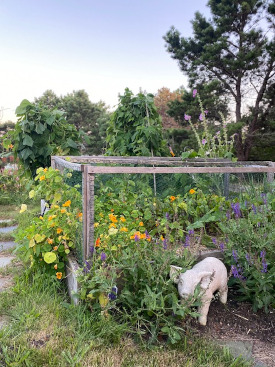
Gardens can be whimsical. This is the entrance to Jill May’s garden. (Photo: Jill Mays)
BELTRAN: You said, the number one thing for making gardening accessible for neurodiverse people is that they have a successful experience. What do you mean by a successful experience, and how do you do that?
MAYS: That's a great question. First of all, you really want them to feel joy. You want them to experience joy when they're in the garden, and the first thing is that they feel like they understand what's happening and they're capable of doing what is asked of them. You don't want them to feel overwhelmed. So you're going to make it very clear what the instructions are, and you're going to match the ability with what the individual is capable of doing. You also sort of coach them. And for instance, a lot of times, you know, the first response is, oh, I can't do that. Especially like weeding, you know, bending over, it's like, no, no, no, that's too hard. And so I measure it. I say, look it. I understand it is hard, so no worries. I'm just going to let you, you only need to do five, yank up five weeds, you know? And I say, 12345, and I give them a big hands, you know, yay, hooray. You did a great job, and you are all done. So you do incrementally, you don't start with, okay, today we're going to weed and we're going to plant, and where you just take little tiny tidbits of activities at a time. And I will say that over time, those individuals, for instance with the weeding, that are like, I can't do that, whether it was for tactile reasons or endurance reasons, by the end of the season, we're yanking up entire beds pretty successfully. So it builds over time.
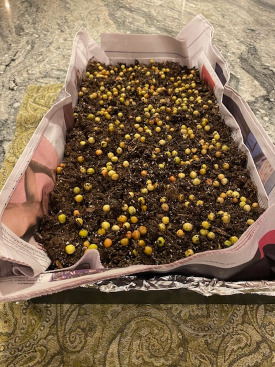
A great inside winter garden activity: pea shoots! In a few weeks you’ll have tasty 6-8 inch shoots for salads and stir fries. (Photo: Jill Mays)
BELTRAN: And then what about for people with physical disabilities, like people who use a wheelchair? How do we make gardening more approachable for those populations?
MAYS: Yes, that's a great question, and I might add that for a lot of the neurodiverse people, many of them have some physical limitations. So all the things that we just talked about are applicable and that we're going to talk about now specifically. So there's a lot of ways that you can activate making gardening accessible. One is something called a table bed, where you actually have the bed where you put the soil, and it's like, it literally is like a table with a lot of clearance, so wheelchairs can go underneath it, and they can work directly there. And obviously just having higher raised beds is helpful, but there's other strategies that you can use as well, like doing vertical gardening. So you have pots and then you have things growing, so it's much easier for someone with a walker or a wheelchair to reach. And then there's pots that you can put on dollies and move to the location that people are, as opposed to them having to go to it. And then for people who are still mobile but are starting to find their bodies are saying, this is too much for me, there's wonderful things like chairs and benches. And I just started because I needed to demonstrate at all the talks I give, you know, some examples of this. I got this beautiful purple kneeler that I absolutely love, because now I used to be able to only garden for about an hour or so, and then my body was saying, stop it. And now I am back to gardening three, four or five hours, because it distributes, I can push down with my arms so that it's not just my knees and hips. I can distribute all of the stress throughout my body instead.
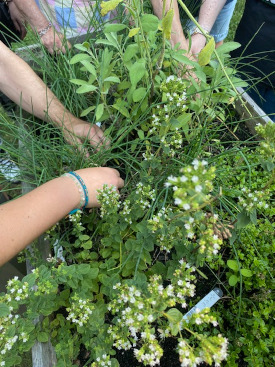
Group members from Cape Abilities at work weeding. Our guest Jill Mays says, "many hands make light the work". (Photo: Jill Mays)
BELTRAN: Yeah. One thought that came to mind when reading your book is that, you know, we will all progress into becoming differently abled people, right? So all of these tips and tricks are really useful for, for all of us, honestly, at the end of the day.
MAYS: Yeah, exactly. So the title of the book is, For Special Needs, Gardening for Special Needs . But we really all have special needs. And from the, from the birth, you know, from the cradle, children really need to be engaged, moving and outside. As we get older, we need to disconnect from our devices to help de-stress, and then way at the other end of the life cycle, it's a use it or lose it situation. So whereas children are gardening to develop skills, the elderly are gardening in a way that can help them maintain skills, in ways that, you know, just going to the gym doesn't do. It's incredibly impactful.
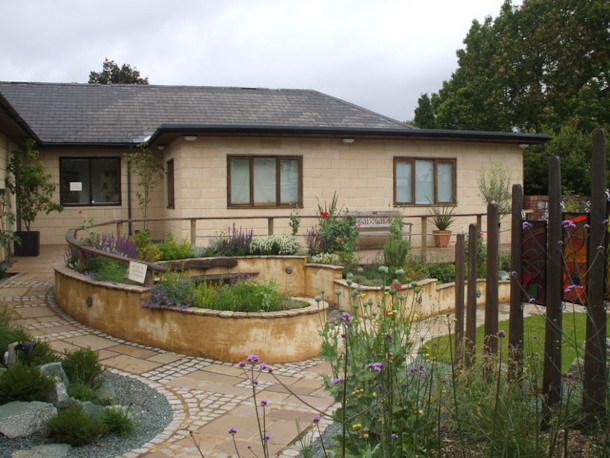
The Sensory Garden in the grounds of St Christopher's School in Westbury Park, Bristol, a school for children with special needs. (Photo: Michael Murray, Wikimedia Commons, CC BY SA 2.0)
BELTRAN: As a society, what do we lose by not incorporating differently abled people into nature-based activities like gardening?
MAYS: Well, these are the most vulnerable people, you know. They have a lot of stress in their life from internal things, and also they are oftentimes isolated. And gardening is something, as we've mentioned throughout talking, that there's so many ways that it helps to calm us down, de-stress us, it makes us healthier. And so they will be able to benefit enormously. But the other thing is that these are wonderful people, and gardening is a great equalizer, and so people of all different walks of life can garden together. And so it is an opportunity that there's more of a commingling, so to speak, and that both can share together in the joys of gardening.
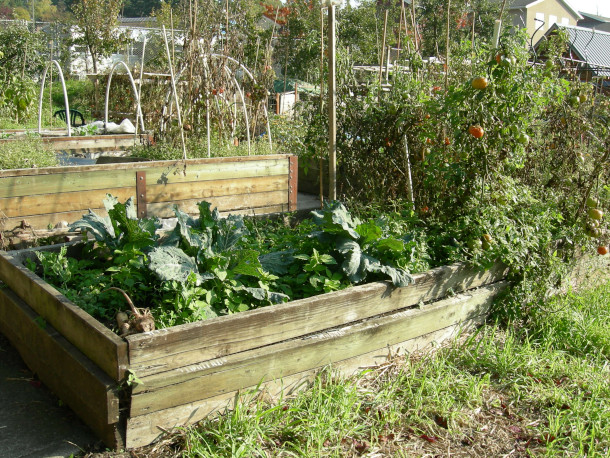
Picardo Farm, Wedgwood neighborhood, Seattle, Washington. A community allotment garden with raised beds for the physically disabled. (Photo: Joe Mabel, Wikimedia Commons, CC BY SA 3.0)
BELTRAN: Jill Mays is the author of Nurturing Nature: A Guide to Gardening for Special Needs . Jill, thank you so much for joining us.
MAYS: Oh, thank you. It was wonderful.
Links
Learn more about Cape Abilities
Learn more about Sustainable C.A.P.E’s Children’s Community Garden at Truro Public Library
Living on Earth wants to hear from you!
Living on Earth
62 Calef Highway, Suite 212
Lee, NH 03861
Telephone: 617-287-4121
E-mail: comments@loe.org
Newsletter [Click here]
Donate to Living on Earth!
Living on Earth is an independent media program and relies entirely on contributions from listeners and institutions supporting public service. Please donate now to preserve an independent environmental voice.
NewsletterLiving on Earth offers a weekly delivery of the show's rundown to your mailbox. Sign up for our newsletter today!
 Sailors For The Sea: Be the change you want to sea.
 The Grantham Foundation for the Protection of the Environment: Committed to protecting and improving the health of the global environment.
 Contribute to Living on Earth and receive, as our gift to you, an archival print of one of Mark Seth Lender's extraordinary wildlife photographs. Follow the link to see Mark's current collection of photographs.
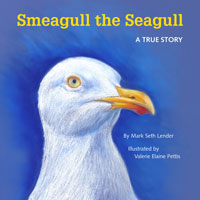 Buy a signed copy of Mark Seth Lender's book Smeagull the Seagull & support Living on Earth
© Copyright World Media Foundation. All Rights Reserved
Home | Contact | RSS | Donate | Newsletter