

Out-of-this-World Discoveries from 2025
Air Date: Week of January 2, 2026
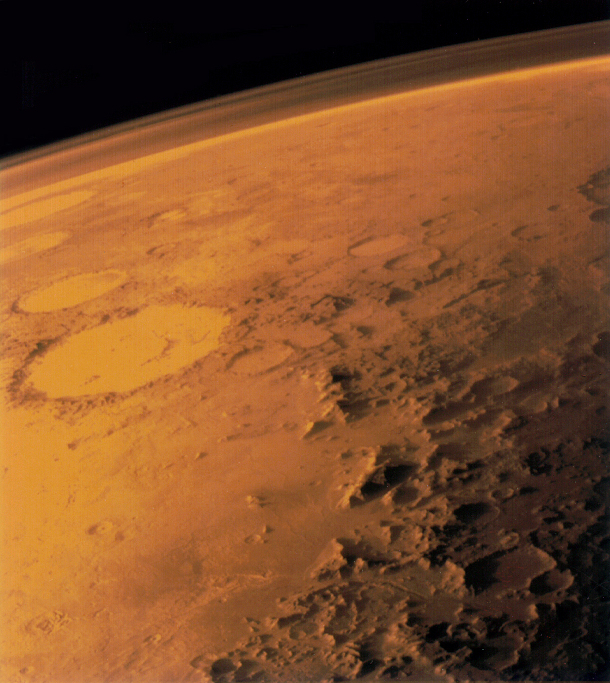
Mars is a desert planet, but its rock formations suggest the planet may have had liquid water in the past. As one of our closest planetary neighbors, Mars is a hotbed of scientific discovery beyond Earth. (Photo: NASA, Wikimedia Commons, public domain)
2025 brought some exciting extraterrestrial scientific discoveries that might have been missed amid other headlines. Hosts Aynsley O’Neill and Jenni Doering discuss new evidence about the Martian environment and the possibility of past life on Mars, the discovery of important building blocks of life in samples from the asteroid Bennu, and observations of the third interstellar object that’s been documented in our solar system.
Transcript
DOERING: From PRX and the Jennifer and Ted Stanley studios at the University of Massachusetts, Boston, this is Living on Earth. I'm Jenni Doering.
O'NEILL: And I'm Aynsley O'Neill. And Jenni, I haven't seen you since last year, so first things first, happy 2026!
DOERING: Yes, Happy New Year, Aynsley! I can't believe we're leaving 2025 behind already, but before it shrinks too much in the rear-view mirror, let's take a moment to look back on some exciting recent news about space that I think we probably all might have missed.
O'NEILL: Jenni, I am chomping at the bit to bring you this because 2025 had some really cool advancements in the world of space science, especially when it comes to one of our closest planetary neighbors, Mars, and being the space nerd I am, I am jumping at the opportunity to share them with you.
DOERING: Well, I will never deny you the opportunity to nerd out about space. So what you got for us?
O'NEILL: So to start, just like our home planet, the Martian surface occasionally plays host to dust devils, these swirling whirlwinds that form when hot air rises quickly and starts to spin. And on Mars, these can get huge. I'm talking absolutely massive. One reached even over a mile in height. And we've known about them since the 80s, but in 2025 scientists confirmed the existence of electrical activity in those dust devils, just like we sometimes get here on Earth.

It turns out “dust devils” on Mars, swirling whirlwinds that form when hot air rises quickly, sometimes contain electrical activity, according to 2025 research. (Photo: NASA/JPL-Caltech/SSI, Wikimedia Commons, public domain)
DOERING: What? You mean, like lightning on Mars?
O'NEILL: Well, okay, so pop science has been calling them "mini lightning strikes," but the research article itself uses the technical term, "triboelectric discharges," which I had to look up, but it's the kind of electric activity that's generated from friction. And if you listen to the sounds that the perseverance rover recorded, to me, it definitely sounds closer to a static shock. I'll play it for you. It's pretty subtle, so you should listen close.
[SFX triboelectric discharges]
DOERING: Oh yeah, actually, it's taking me back to being at the science museum as a kid, and you know those metal spheres that you could put your hand on and it would make your hair stand on end?
O'NEILL: Yes, yes, yes. Exactly makes me think of that.
DOERING: Yeah, and like the crackling sounds...All right, but I thought that we did know that there was lightning on other planets, not just our own. So what's exciting about the fact that there's lightning on Mars?
O'NEILL: Well, you're right. So there are lightning storms on planets like Jupiter and Saturn, but this confirms that the Martian atmosphere can become electrically charged, and that knowledge can help us learn more about the kinds of chemical reactions that could naturally occur on the surface of the planet.
DOERING: Oh, okay. I mean knowing about possible lightning strikes also seems like it would be really important for like, the stuff we're sending up there, rovers, any future human habitats or exploration, pretty important to know if you're going to get zapped. But I know there's a ton of space science that we're looking at on Mars, and I just love hearing about what we're learning about whether life ever existed there. So Aynsley, you know, did 2025 bring us any closer on that front?

An image taken by the Perseverance Rover at the Cheyava Falls boulder site on Mars. A rock sample collected by the rover, nicknamed “Sapphire Canyon,” appears to show patterns associated with microbial activity and compounds that usually form in the presence of life. It’s not yet a confirmation, though, of a history of life on Mars. (Photo: color processing by areo.info, raw data by NASA/JPL-Caltech, Wikimedia Commons, CC BY 4.0)
O'NEILL: I feel like every year we get a little closer to finding out. There's been pretty exciting news. Researchers have been studying the rocks on Mars, because God knows, if there's one thing Mars has, it's rocks, and they've noticed what they called a “potential biosignature” in this sample that they nicknamed “Sapphire Canyon.” And to be clear, when I say “potential biosignature,” the word “potential” does a lot of heavy lifting there.
DOERING: Okay, but hold up. I thought we hadn't actually gotten any rock samples back from Mars yet, because it's just really hard to do that. So how exactly did researchers determine this?
O'NEILL: We come back once again to our trusty rover friend, Perseverance, here. There are a lot of things that scientists can do from afar, thanks to that rover, which has all these little science instruments on there, doing some really cool research on these rocks. And what scientists were really interested in for this particular rock was these speckles that kind of look like colorful leopard spots?
DOERING: Wait a minute, how much like leopard spots?
O'NEILL: Okay, it's really not as orange as or as uniform as actual leopard print would be. But if you look, they're lighter tan specks that are ringed by these darker grayish lines, so you could see where the connection was made. And these patterns are, at least here on Earth, typically associated with microbial activity. So that's pretty interesting. And to top it off, the Martian rock also showed signs of organic compounds, which are the chemical building blocks of life. So altogether, it's pretty close to what we would expect to see if microbial life had gotten onto that rock and started eating up its organic carbon, sulfur and phosphorus for energy.
DOERING: Oh, wow. And, you know, we've known for a while now that liquid water probably once flowed on the surface of Mars. So we've got water, we've got what seems to be these signs of microbes consuming energy, it sounds a lot like life as we know it.
O'NEILL: I know, it feels like it's all coming together, but it's not quite a smoking gun. The minerals on the rock are often tied to biological processes, but it's hard to entirely rule out that they may have been caused without life being involved, but it seems like it raises the likelihood that some kind of life might have been involved here, and for that reason, it's one of the most exciting developments for astrobiologists in recent years.
DOERING: Wow, so cool. So I know we're looking for life in a lot of different places around our solar system. And I actually did hear that there's been some new science along these lines out of the asteroid Bennu. Do you know what I'm talking about?
O'NEILL: Oh, Jenni, I love the asteroid Bennu. We owe so much to the asteroid Bennu. You'll remember that I did an interview with Dr. Vicky Hamilton about this back in 2023. She was a part of this OSIRIS-REx mission that, as opposed to Mars, actually has brought back samples from the asteroid.
DOERING: Yes.
O’NEILL: And ever since, scientists around the world have been studying those samples pretty intensely. And I think the new science that you're talking about, maybe those sugar molecules, Jenni?
DOERING: Yes, you're jogging my memory. Yeah, I watched a YouTube video about this, but tell me more.
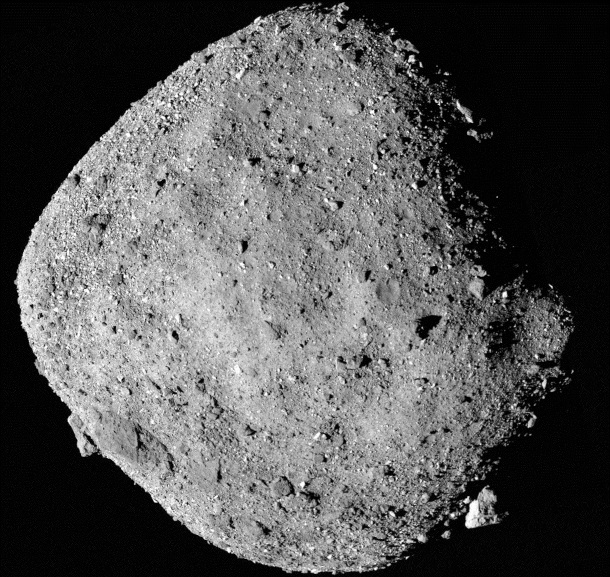
A Japanese research team discovered examples of ribose and the first ever extraterrestrial example of glucose on the asteroid Bennu. (Photo: NASA/Goddard/University of Arizona, Wikimedia Commons, public domain)
O'NEILL: Okay, so there was this Japanese team that found examples of ribose, as well as the first ever extraterrestrial example of glucose, and both of those are sugars that are massively important for biology on Earth, ribose is a part of DNA and RNA, and of course, glucose is one of the key building blocks of food for many organisms, including ourselves, and other samples from Bennu have also shown signs of some of life's other building blocks. We're talking amino acids, nucleobases, carboxylic acids, all this stuff that helps life as we know it work together.
DOERING: Wow. Okay, so again, maybe not a smoking gun, but I think it really shows that some of the key ingredients are there and like throughout the solar system.
O'NEILL: I know. Even on an asteroid. I think that since living on Earth is our only real blueprint for how life works, it's pretty easy to think that any other life would also be found on a planet like ours. I know we're looking at Mars, I know we're looking at some of Jupiter's moons, but finding sugars and amino acids even on an asteroid really is opening my mind to all the possibility that's out there.
DOERING: Wow. And when you think about how many asteroids are out there, this is really kind of mind blowing,
O'NEILL: And how much out there is out there. Jenni, I've actually got one more piece of news from our third ever interstellar object that was observed. So our third ever visitor from outside the solar system.
DOERING: Oh yeah, I have seen some headlines about this. So what can you tell me?
O'NEILL: Well, so the first one was only discovered in 2017. That was called 1I/ʻOumuamua. And following that naming pattern, this is 3I/ATLAS, which we only saw last summer, coming in as a comet from another solar system.

The interstellar comet, 3I/ATLAS, captured by the Gemini Multi-Object Spectrograph. (Photo: Processed by J. Miller, M. Rodriguez, T.A. Rector, M. Zamani, International Gemini Observatory/NOIRLab/NSF/AURA/B, Wikimedia Commons, CC BY 4.0)
DOERING: Oh, my gosh. So what do we know about this interstellar visitor? Could it be aliens?
O'NEILL: Oh, people were definitely thinking aliens. With each of these, 1I/ʻOumuamua and 3I/ATLAS, every single one, people are going, "Aliens"? But as far as we can tell, no, not yet. This is just a sort of classic comet with a solid ice core and a tail coming off the end. It's picture perfect, Jenni.
DOERING: Well, it sounds pretty. Can I look up in the night sky? Can I see this thing?
O'NEILL: All right, not with your naked eye, Jenni. You're gonna need a telescope, or we've got some pictures that we'll be sure to post on the website. But it came closest to Earth last year, December 19, and it's still in the solar system, so we're still observing it, but it'll be headed past Jupiter in March. So we got to get our science in now, because once it's gone, it's gone.
DOERING: Wow. This is it. One chance. And I know that, you know, scientists are probably going to be poring over that data for months and years to come. So I'm sure you'll keep us posted on what they find.
O'NEILL: Well, Jenni, you know me, so you can rest assured, I will be paying attention to all the space science that's coming up soon.
DOERING: And maybe someday we'll send you on assignment to Mars.
O'NEILL: Mars! Jenni, oh my gosh, don't tempt me like this.
DOERING: Well, we can dream. Well, thanks as always, Aynsley, this has been really fun.
O'NEILL: Thank you, Jenni.
Links
NASA | “NASA Rover Detects Electric Sparks in Mars Dust Devils, Storms”
NASA | “NASA Says Mars Rover Discovered Potential Biosignature Last Year”
Nature Geoscience | “Bio-Essential Sugars in Samples From Asteroid Bennu”
Living on Earth wants to hear from you!
Living on Earth
62 Calef Highway, Suite 212
Lee, NH 03861
Telephone: 617-287-4121
E-mail: comments@loe.org
Newsletter [Click here]
Donate to Living on Earth!
Living on Earth is an independent media program and relies entirely on contributions from listeners and institutions supporting public service. Please donate now to preserve an independent environmental voice.
NewsletterLiving on Earth offers a weekly delivery of the show's rundown to your mailbox. Sign up for our newsletter today!
 Sailors For The Sea: Be the change you want to sea.
 The Grantham Foundation for the Protection of the Environment: Committed to protecting and improving the health of the global environment.
 Contribute to Living on Earth and receive, as our gift to you, an archival print of one of Mark Seth Lender's extraordinary wildlife photographs. Follow the link to see Mark's current collection of photographs.
 Buy a signed copy of Mark Seth Lender's book Smeagull the Seagull & support Living on Earth
© Copyright World Media Foundation. All Rights Reserved
Home | Contact | RSS | Donate | Newsletter