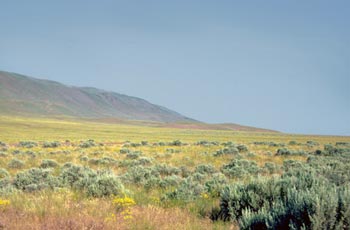
 (Photo: USGS researchers) (Photo: USGS researchers)
YOUNG: Norton insists the Fish and Wildlife Service will make this decision based on science, as the law requires. But she's clearly hopeful that some land management strategy will allow both habitat preservation and some development.
CURWOOD: I want to discuss how the Interior Department might try to strike that balance, but first Jeff, let's talk about the concerns Secretary Norton mentioned. How would oil and gas drilling be affected by this exactly?
YOUNG: The Bush administration, as you know, places a lot of emphasis on increasing the domestic energy supply. This goes back to, say, Vice President Cheney's energy task force, where we saw a lot of pressure to allow more exploration and drilling on public lands. Some estimates say there's a trillion dollars worth of oil and natural gas under the intermountain west, and much of it is probably under some sagebrush land. So industry groups see this as a collision course. They're calling the sage grouse "the spotted owl on steroids."
CURWOOD: The spotted owl, of course, being one of the big endangered species disputes of the past, tied in with logging old growth forests in the Pacific Northwest. What are business groups doing now, Jeff?
YOUNG: Well, they're challenging the data the environmentalists used in their petition to list the sage grouse. But they're doing more than that. Joe Sims represents ranchers, drillers and some developers in a group called Partnership for the West. Sims says the grouse doesn’t need endangered status because the folks he represents recognize what could happen if the bird is listed, and that has sufficiently motivated them to get together and come up with ways to preserve habitat.
SIMS: I don't think there's ever been a more coordinated range-wide conservation effort aimed at any species than with the greater sage grouse. Now that that's going on, our message to Washington is let that continue. Don't come in and do a federal takeover of our local conservation efforts, because that federal takeover ends up chilling those local conservation efforts.
YOUNG: Western state wildlife agencies have come together on this. And there's another major player: that's the Department of Interior’s Bureau of Land Management. BLM controls about half the possible sage grouse habitat. It's just released its strategy for sage grouse conservation, which is aimed at conserving and enhancing sagebrush habitat.
CURWOOD: And how is that conservation plan being received?
YOUNG: Well I talked with a scientist who worked with sage grouse for nearly twenty years before he retired, Clait Braun. Braun’s work is cited in that BLM strategy, and here's what he thinks of it.
BRAUN: I think it's a feel-good document. I think it’s exceedingly shallow, I think it’s a lot of smoke and mirrors. Basically, the BLM remains in denial that sage grouse has a problem and that they can do anything about it.
CURWOOD: Well that’s far from a ringing endorsement, Jeff. How do the environmental groups see this shaping up?
YOUNG: They point to the access that industry has to this administration. For example, Mr. Sims of the Partnership for the West, who we heard from, he worked in the Bush White House and helped Vice President Cheney with his energy task force.
Jacob Smith directs the Center for Native Ecosystems in Denver. Smith thinks that access, that pressure will play too large a role in this decision, and, in fact, Smith says he’s already seen that in other recent negative decisions on whether to list some western species.
SMITH: Fish and Wildlife Service bowed to industry pressure. So it’s a pattern that’s becoming ever more prevalent. I'm happy to reserve judgment, and we'll see what the Fish and Wildlife Service does.
YOUNG: The decision deadline is December 29, and either way it goes, I’m guessing you can expect some litigation to follow.
CURWOOD: Jeff Young is Living on Earth’s Washington correspondent. Thanks, Jeff.
YOUNG: You’re welcome.
[MUSIC: Pat Metheny Group “The Search” AMERICAN GARAGE (ECM – 1979)]
CURWOOD: As always, we welcome your comments. But today we want to encourage you to take advantage of the opportunity to step in front of an open microphone here on Living on Earth. Maybe you’ve always wanted to tell a special story about experiences, concerns and feelings about the natural world we all share. Well, we’re all ears. We invite you to send us a brief recording.
Making one can be as simple as picking up the telephone, or using some of that sound gear you have lying around the house. Our web site, Living on Earth dot o-r-g, has the instructions and some suggestions to help you. Works may be chosen for production, posted online and perhaps broadcast.
Now, this is not a contest. There are no winners or losers. This is simply an invitation to you to get involved. What do we want to hear? Your opinions count, of course, but even better are stories, tales from your life on this planet that we all share. So visit Living on Earth dot o-r-g for complete directions and some sample stories. And if you’re not online, send us a card, and we’ll send you some instructions. The address is Stories, Living on Earth, 20 Holland Street, Somerville Massachusetts, 02144.
CURWOOD: Coming up: strategies of survival—why some make it against seemingly impossible odds. Stay tuned to Living on Earth.
[MUSIC: Charlie Haden/Hank Jones “Nobody Knows the Trouble I’ve Seen” STEAL AWAY (Verve – 1995)]
Living on Earth wants to hear from you!
Living on Earth
62 Calef Highway, Suite 212
Lee, NH 03861
Telephone: 617-287-4121
E-mail: comments@loe.org
Donate to Living on Earth!
Living on Earth is an independent media program and relies entirely on contributions from listeners and institutions supporting public service. Please donate now to preserve an independent environmental voice.
NewsletterLiving on Earth offers a weekly delivery of the show's rundown to your mailbox. Sign up for our newsletter today!
 Sailors For The Sea: Be the change you want to sea. Sailors For The Sea: Be the change you want to sea.
 The Grantham Foundation for the Protection of the Environment: Committed to protecting and improving the health of the global environment. The Grantham Foundation for the Protection of the Environment: Committed to protecting and improving the health of the global environment.
 Contribute to Living on Earth and receive, as our gift to you, an archival print of one of Mark Seth Lender's extraordinary wildlife photographs. Follow the link to see Mark's current collection of photographs. Contribute to Living on Earth and receive, as our gift to you, an archival print of one of Mark Seth Lender's extraordinary wildlife photographs. Follow the link to see Mark's current collection of photographs.
 Buy a signed copy of Mark Seth Lender's book Smeagull the Seagull & support Living on Earth Buy a signed copy of Mark Seth Lender's book Smeagull the Seagull & support Living on Earth
| 

 Environmental groups petitioned the government to give the sage grouse the protection of the Endangered Species Act. Western states, the oil and gas industry, as well as some cattle ranchers and developers, have mobilized to stop that. It's one of the most closely watched endangered species decisions in years. Our Washington correspondent Jeff Young has been watching and joins us now to talk about what's at stake. Jeff, welcome.
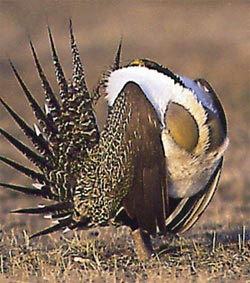 Male Sage Grouse (Centrocercus urophasianus) (Photo: USGS researchers)