

Got the Beat
Air Date: Week of July 2, 2004
Tod Machover is a professor, classical musician and inventor at the MIT Media Lab who is overseeing the design of a new class of electronic instruments. These beat bugs, shapers and other musical inventions are now used by children, handicapped adults and orchestras around the world. Living on Earth’s Susan Shepherd reports on the new frontier of Hyper Music.
Transcript
CURWOOD: It’s Living on Earth. I’m Steve Curwood. Among the things that distinguish humans as a species is our ability to make and recreate music with instruments as well as our voices. At the Massachusetts Institute of Technology, a professor is gaining worldwide attention for his unusual inventions.
For the past two decades, Tod Machover has been designing a variety of electronic gadgets that help non-musicians learn about and create music in unconventional ways. Professor Machover has worked with the youngest of children to the severely handicapped to the most famous classical musicians and composers. And the common thread is that all of his inventions are turning traditional music on its ear. Living on Earth’s Susan Shepherd has our story.
SHEPHERD: Tod Machover’s office at MIT’s media lab is crammed with inventions that look a lot like toys, but they’re really instruments designed to teach kids about music in non-traditional ways. Some of the gadgets focus on beat and rhythm. Others teach kids how to invent new sounds and lets them compose their own music. And some offer kids the chance to create something entirely new.
MACHOVER: It’s one thing to turn kids into musicians and performers and composers. But there's no reason we can't turn kids into instrument designers and inventors of new kinds of music play also.
[ELECTRONIC BEATS – UP AND UNDER]
SHEPHERD: Take, for example, the beat bug. The beat bug is a palm-sized plastic invention that looks like a ladybug complete with antenna. Machover calls it a toy with personality.
|
|
 MACHOVER: It’s actually a little like electronic hot potato since one of the reasons for passing it around is you never know when it’s going to come to you and you have to react right away.
SHEPHERD: Machover designed the beat bug with one of his students, Rob Einey, and like a proud father, Einey spreads eight of his creations out on a table and hooks them up them to a computer. EINEY: You begin by creating a pulse, and then you can play a simple pattern like [ELECTRONIC BEATS]. And then it hops over to another of the beat bugs. [MORE ELECTRONIC SOUNDS] EINEY: And then you can use these antennas on it to control the pitch of the note and to ornament it with these extra notes. And when you’re happy with your transformation of it you hit it again and it jumps over to another beat bug. SHEPHERD: And then the next child whacks the beat bug and creates yet another rhythm. Like all of the gadgets the Media Lab makes for children, the beat bug is designed to remove the often huge threshold of technical difficulty that normally separates a child from the ability to learn traditional musical instruments. The point, Machover says, is to give a child something that doesn’t - by nature - limit his or her skills. The more the child plays, he says, the better he or she gets. MACHOVER: Often what we do is set up a workshop where you work with a group of kids maybe every day for a week leading up to a concert. Then you can really do things like start with clapping and think about how rhythm works and play some rhythm games, and then finally a piece that’s written that they really have to practice. [MUSIC] SHEPHERD: Tod Machover is a little like one of his beat bugs. He starts with an idea, then sends it off to someone else who changes it and sends it back. Then Machover lets it go without knowing or fearing the consequences. MACHOVER: I mean, obviously, part of it is making a stab at putting things out in the world, which we think are worth using as models and worth sticking. And also, realizing that you put these things out there and the way people react to them and what they build in relationship to it and what it becomes is out of our control, of course. SHEPHERD: The ideas that spill out of Machover and his colleagues at the MIT Media Lab have attracted high praise. The New York Times calls Machover “brilliantly gifted.” The French Cultural Ministry has awarded him the equivalent of its Pulitzer Prize. And symphony orchestras are now incorporating Machover’s lab instruments in their performances. [MUSIC: Tod Machover “Nature Suite” TOY SYMPHONY (BBC Broadcast – 2002)]
|
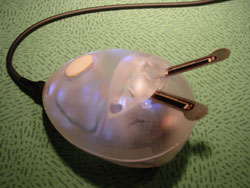 A beat bug (Photo: MIT Media Lab)
 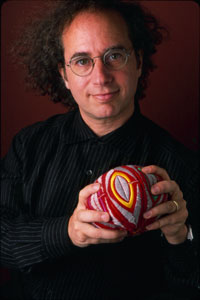 Tod Machover with music shaper (Photo: Webb Chappell)
 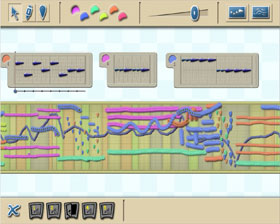 Hyperscore Screen Shot (Photo: MIT Media Lab)