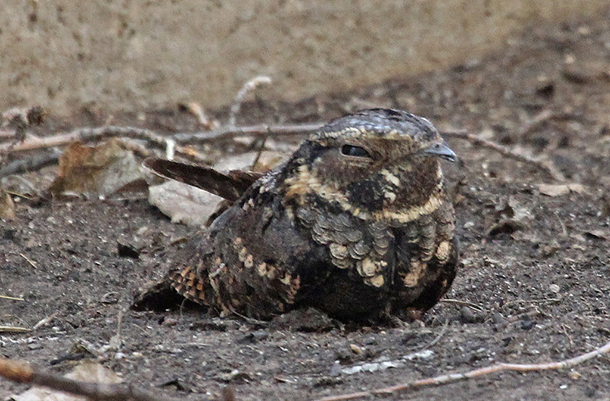
Eastern Whip-poor-wills have brindled plumage, which camouflages them well amongst dead leaves and tree bark. (Photo: Jerry Oldenettel, Flickr CC)
Eastern Whip-poor-wills are not technically songbirds, but their calls function as a song. (Photo: Laura Gooch, Flickr CC)
Most songbirds sing during the daylight hours, but it’s the Eastern Whip-poor-will that comes alive as the sun sets. BirdNote’s Michael Stein reads Henry David Thoreau’s account of the lovely nightjar bird’s song and notes how habitat loss is causing the population’s decline.
CURWOOD: It’s Living on Earth, I'm Steve Curwood.
[MUSIC: BIRDNOTE® THEME]
CURWOOD: Now the shrinking of forests in the US is having noticeable effects on wildlife, and particularly birds that rely on tree cover to nest. One of them is the star of today’s BirdNote. Here’s Michael Stein.
BirdNote®
Eastern Whip-poor-will – Bird of the Night Side of the Woods
[Whip-poor-will song throughout]
In September of 1851, Henry David Thoreau wrote:
“The Whip-poor-wills now begin to sing in earnest about half an hour before sunrise, as if making haste to improve the short time that is left them.
[Whip-poor-will song]
Eastern Whip-poor-wills have brindled plumage, which camouflages them well amongst dead leaves and tree bark. (Photo: Jerry Oldenettel, Flickr CC)
…They sing for several hours in the early part of the night, then sing again just before sunrise.”
Clearly and continuously, the bird announces its name [Whip-poor-will song].
In summer to early fall, Eastern Whip-poor-wills breed in woodlands of eastern North America. Their camouflaged plumage blends seamlessly with dead leaves on the forest floor. At dawn and dusk and all through moonlit nights, whip-poor-wills sally out from tree branches to hawk flying insects.
Woodland habitat has greatly diminished for Eastern Whip-poor-wills, as forests become more fragmented. The National Audubon Society lists them among the Top 20 Common Birds in Decline. Protecting and restoring large expanses of forest are crucial for many forest species, including the whip-poor-will.
[Whip-poor-will song and crickets]
It remains, as Thoreau described: “…a bird . . . of the night side of the woods, where you may hear the whip-poor-will in your dreams.”
I'm Michael Stein.
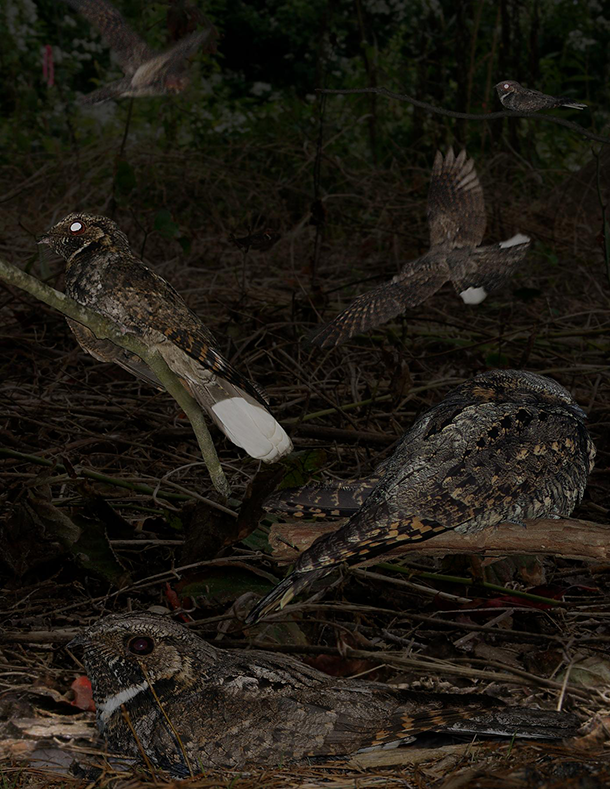
Eastern Whip-poor-wills are part of a bird classification called nightjars. This group is known to be active during the late evening, night and early morning. (Photo: Richard Crossley, CC BY-SA 3.0)
###
Written by Frances Wood; revised by Bob Sundstrom
Bird sounds provided by The Macaulay Library of Natural Sounds at the Cornell Lab of Ornithology, Ithaca, New York. Song of the Whip-poor-will (Eastern) [84871] recorded by W.L. Hershberger. BirdNote’s theme music was composed and played by Nancy Rumbel and John Kessler.
Producer: John Kessler
Executive Producers: Chris Peterson/Dominic Black
© 2015 Tune In to Nature.org September 2015 Narrator: Michael Stein
Whip-poor-will on branch - Laura Gooch https://www.flickr.com/photos/lgooch/6991532244
Whip-poor-will on ground - Jerry Oldenettel https://www.flickr.com/photos/jroldenettel/6199157613
http://birdnote.org/show/whip-poor-will
Links http://birdnote.org/show/whip-poor-will - Whip-poor-wills on BirdNote® http://www.allaboutbirds.org/guide/Whip-poor-will/id - More about Whip-poor-wills on All About Birds http://www.audubon.org/field-guide/bird/eastern-whip-poor-will - Whip-poor-wills on Audubon’s Guide to North American Birds