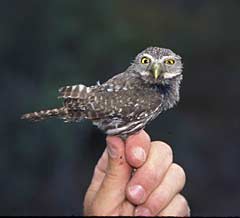
The endangered pygmy owl. (Courtesy of National Park Service)
PETERSON: Tibbits calls for a cactus ferruginous pygmy owl. It’s the size of his fist and hard to hear. This canyon, its saguaro cactus, and mesquite, is prime territory for the owl, endangered under federal law. But foot trails, pounded down by hundreds of people and off road driving, worry the owls and Tibbits.
TIBBITS: I have had a couple of these nest territories that were active and they were feeding young, or they were incubating eggs, and then we saw some of this illegal activity occur in the territory, literally within 50-100 feet of the nest site. And then the territories have been abandoned.
PETERSON: Other animals, some of them rare, migrate across the border. Walls would prevent that, so local agencies have worked together for barriers that block people but not animals. This is one of them. Metal posts, set in concrete, sit on an 18-mile stretch at the park’s border. They’re crossed with railroad ties three feet up. Animals get through. Cars can’t. Organ Pipe’s Chief of Resources Mary Kralovec says public involvement–currently required for the National Environmental Policy Act–isn’t a burden. It got the barrier built.
KRALOVEC: The biggest most important part of the NEPA process is the public involvement. So if you get rid of that process you get rid of the public involvement process. The public has the opportunity to comment on the federal action.
PETERSON: But even a lengthy process couldn’t counter the push north. Border jumpers stymied by the vehicle barrier now head next door, into Cabeza Prieta National Wildlife Refuge. A fleet of abandoned cars rust there, near the Palo Verde trees. Smugglers have cut roads across river washes and through creosote. Last month, 13 migrants, lost, without water, set signal fires hoping for rescue. They were rescued, but the fire tore through 1,000 acres of land. The park’s superintendent, Roger DiRosa, seems astonished as he walks to a lookout over these lands under assault.
[DIROSA WALKING]
PETERSON: He says border patrol has lately requested more access.
DIROSA: Unlimited access, cross-country access, four wheel drive, wherever they need to grow. Any kind of infrastructure necessary anywhere–and our contention was, ‘whoa, we support you but this is unnecessary.’
PETERSON: DiRosa has to walk a fine line. He wants to stay part of what border patrol is doing, so he’s worked out compromises with them. These local compromises are hard work. With the new law, they’ll be unnecessary or they could be overruled by Washington. Di Rosa may find himself negotiating the environment with a more powerful partner.
DIROSA: The problem is, it’s a bit like being governed by a dictator--is he going to be benevolent or is he going to be malicious? As long as he’s benevolent, it’s great.
PETERSON: Especially because the ecosystem is an unforgiving one. Three years ago, Arizona’s population of Sonoran pronghorn, a fast, deer-like animal, crashed. Just 18 survived a harsh drought year. Cabeza Prieta biologist Mike Coffeen manages pronghorn recovery. He says with drought years ahead there’s little room for error.
COFFEEN: What we worry about is when we get into the next severe drought cycle there’s so much activity now that it could have a serious impact on the pronghorn when they’re already stressed.
PETERSON: He points out a breeding enclosure, surrounded by electric fence. Concerned that helicopters would drive pronghorn to panic inside, biologists asked border patrol to keep clear. They have. This spring, ten fawns were born. David BeMiller says there’s no danger that kind of collaboration will disappear.
BEMILLER: At no time are we going to patrol the border without consulting other folks. It’s not worth protecting if it’s destroyed in the meantime.
PETERSON: Consultation could continue. But if it doesn’t, aggrieved parties will have little recourse. The new law will limit the basis for court challenges. For Living on Earth, I’m Molly Peterson.