

Ode to Powerlines
Air Date: Week of August 14, 2009
(Photo: Brian Rosa)
Power lines give a pulse to the American landscape. So say cartographer Brian Rosa and photographer Adam Ryder who walked, camped, and lived in the shadow of Rhode Island’s power lines to try to understand how they impact the environment and people. Producer Ike Sriskandarajah uncovers how the ubiquitous pylons and lines capture the imagination. (6:15)
Transcript
GELLERMAN: It’s an encore edition of Living on Earth. I’m Bruce Gellerman. High-tension transmission lines carry the current that powers the country. Typically the giant towers and cables get no respect as we buzz by in our cars paying them no mind, but Living on Earth’s Ike Sriskandarajah found two live wires who love the lines, and has our story.
SRISKANDARAJAH: So these two guys – a cartographer ...
ROSA: My name is Brian Rosa.
SRISKANDARAJAH: ...and a photographer ...
RYDER: My name's Adam Ryder
SRISKANDARAJAH: ... have been fascinated by power lines from a very young age.
RYDER: I spent a long time in the car with my parents on really long car rides, and I was an only child, so I would be looking out the window a lot.
SRISKANDARAJAH: Looking out the window, Brian and Adam both noticed these gently undulating curvy lines.
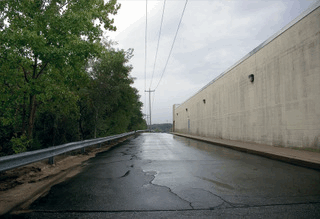
“….back to my teenage years a little bit.” (Photo: Brian Rosa)
[MUSIC: "I DON'T HAVE TO TRY. I DON'T HAVE TO SPEAK. I CAN WATCH THE COUNTRY SIDE." THE SOUND OF A CAR STARTING. MUSIC: "AND I CAN FALL ASLEEP"]
SRISKANDARAJAH: There's something dreamy about the power lines and the land under them.
RYDER: Yeah, no absolutely, it's a really unique tract of land that doesn't have any development on it except for itself. So, it's kind of, in a way its really pristine and untouched and...virginal, and it’s kind of, kind of like, romantic and magical in that way.
SRISKANDARAJAH: Something inviting...
RYDER: It doesn't appear to be monitored and there's nobody out there so you can kind of imagine yourself or I would imagine myself like building a little house out there you know, living alone or something like that.
SRISKANDARAJAH: Well young Adam didn't end up moving there.
RYDER: [Laughs] I'd like to think he was that cool.
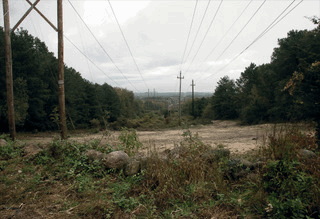
SRISKANDARAJAH: But this past year he and Brian got a grant from Rhode Island's Arts Council to investigate and photograph the high-tension lines that stretch over most of Rhode Island. So they drove out to a small town called Burrillville parked their car and started walking.
RYDER: When I got out of the car I tended to walk along the power lines in whatever direction was opposite of the way Adam was going.
[COUNTRY SOUNDS]
SRISKANDARAJAH: And that's when Brian heard something strange.
(Photo: Adam Ryder)
[CICADA HUM]
ROSA: It didn't actually occur to me that there is this excess energy escaping from these power lines that are actually making a constant electronic hiss all the time
[ELECTRICITY HUM]
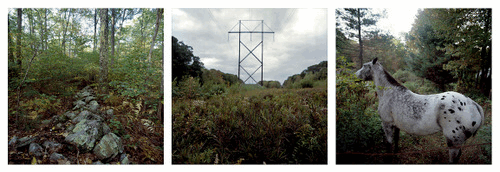
SRISKANDARAJAH: These seemingly empty swatches of land are filled with sound.
ROSA: They make a loud buzzing sound
SRISKANDARAJAH: Maybe you have noticed some sort of sound too as you are driving by pole after pole after pole.
RYDER: They definitely provide a rhythm if you are driving past them on the highway, like if you are a commuter going past all these poles and they are evenly spaced.
[SOUND OF CARS PASSING]
RYDER: Spaced.
[SOUND OF CARS PASSING]
RYDER: Spaced.
[SOUND OF CARS PASSING]
RYDER: Yeah- they kind of create a visual rhythm as they travel along the state.
[SOUND OF CAR DRIVING, MUSIC]
SRISKANDARAJAH: Like a heartbeat. These pillars are more than just dead trees...they really have a life of their own. And as Brian and Adam continued to hike along the lines they saw that the land under and around the pylons is filled with a lot more than just sound.
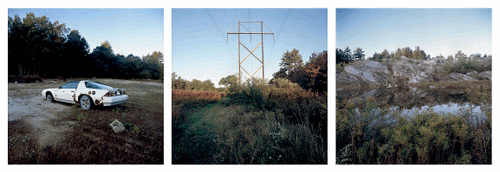
ROSA: We were probably trespassing most of the time while we were there. There were a whole lot of other people doing that too - walking their dogs, riding their ATVs.
(Photo: Adam Ryder)
SRISKANDARAJAH: With a bit of amateur archeology Brian turned up even more.
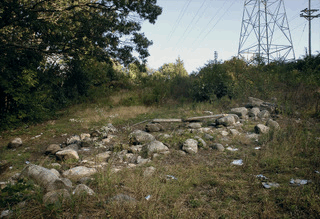
ROSA: Just seeing a fire pit that someone made and a few rocks with a wooden board across them where someone was sitting and people would just go have fires and sit around and drink and be delinquent and it kind of made me think back to my teenage years a little bit.
SRISKANDARAJAH: The power lines carve out a space for people to meet - but Brian and Adam say they connect us in another way.
ROSA: By following these power lines which seemed to cut through disparate areas that aren't necessarily connected when looking from above you actually see that there is a continuum of rural to suburban to urban back to suburban to industrial and that they are all part of a vast network.
(Photo: Brian Rosa)
SRISKANDARAJAH: These are the power lines that bind. For Living on Earth I'm Ike Sriskandarajah.
[MUSIC: The Arcade Fire “In The Backseat” from “Funeral” (Merge Records 2004)]
Links
Living on Earth wants to hear from you!
Living on Earth
62 Calef Highway, Suite 212
Lee, NH 03861
Telephone: 617-287-4121
E-mail: comments@loe.org
Newsletter [Click here]
Donate to Living on Earth!
Living on Earth is an independent media program and relies entirely on contributions from listeners and institutions supporting public service. Please donate now to preserve an independent environmental voice.
NewsletterLiving on Earth offers a weekly delivery of the show's rundown to your mailbox. Sign up for our newsletter today!
 Sailors For The Sea: Be the change you want to sea.
 Creating positive outcomes for future generations.
 Innovating to make the world a better, more sustainable place to live. Listen to the race to 9 billion
 The Grantham Foundation for the Protection of the Environment: Committed to protecting and improving the health of the global environment.
 Contribute to Living on Earth and receive, as our gift to you, an archival print of one of Mark Seth Lender's extraordinary wildlife photographs. Follow the link to see Mark's current collection of photographs.
 Buy a signed copy of Mark Seth Lender's book Smeagull the Seagull & support Living on Earth
© Copyright World Media Foundation. All Rights Reserved
Home | Contact | RSS | Donate | Newsletter