

Down in the Dumps
Air Date: Week of June 26, 2009
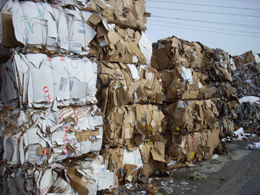
Bales of used cardboard stored behind North Shore Recycled Fibers wait in stacks as the global recycling market struggles to recover. (Photo: Christine Parrish)
The modern recycling movement started thirty years ago in an effort to reduce the amount of garbage going into landfills. It worked. In the process it also became a multi-billion dollar business, with thousands of new products being made out of recycled material. But the global recession has hit the recycling industry hard. Christine Parrish visits a recycling plant in Massachusetts to find trash that used to be turned into cash has sunk to junk value.
Transcript
CURWOOD: It’s Living on Earth, I’m Steve Curwood.
[SOUND OF RECYCLING TRUCK]
CURWOOD: It’s a familiar scene played out on streets across America.
[SOUNDS OF CANS BEING TOSSED INTO TRUCK]
CURWOOD: Workers in recycling trucks grab colorful curbside bins stuffed with cans, bottles and paper.
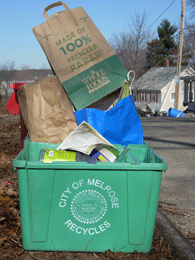
Putting recyclables out by the curb is only the first step in a global supply chain. (Photo: Christine Parrish)
CURWOOD: This is a crucial leg of a round-trip - from consumer to manufacturer and back again to the consumer. These days over 30 percent of household trash is recycled, according to the Environmental Protection Agency
But a funny thing has happened on the way to the reprocessing centers. The floundering global economy has trashed the market. Christine Parrish reports.
PARRISH: The modern recycling movement began as a personal virtue, an earth-friendly civic duty—but today it’s a multi-billion dollar business.
Jerry Powell is editor of: Resource Recycling Magazine.
POWELL: Recycling is one of the most popular environmental movements ever, so when you have 70 percent of people in a community recycling, I think the elected officials will try desperately to keep that program going.
PARRISH: During the economic boom times of the past decade, recycling was a boon to local governments, and to the recycling industry, which made big money grinding up recyclables into the raw materials that are used to make thousands of items, from t-shirts and surfboards to living room carpets.
GOLD: Hi Timmy.
PARRISH: Johnny Gold knows his way around the North Shore recycling plant in Salem, Massachusetts. His grandfather started the business in 1916 and sold it much later. But Johnny Gold stayed on.
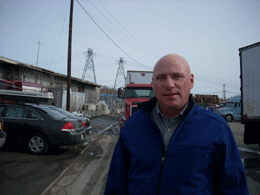
Johnny Gold, a senior vice president for the Recycled Fibers division of the Newark Group, says he has never seen markets for recycled cardboard so low for so long. (Photo: Christine Parrish)
[SOUND OF WALKING DOWN STAIRS]
GOLD: Hi Joey…Oh, buddy…It’s a beautiful day.
[PLANT MACHINE NOISES, FOOTSTEPS]
PARRISH: Gold walks through the loading door to the muddy back lot behind the recycling plant. It’s been raining for days and gray clouds threaten more showers.
[WET FOOTSTEPS]
GOLD: It's bad out here.
PARRISH: But it’s not the weather that troubles Gold.
[SOUND OF TRUCKS BEEPING AND ENGINES REVVING]
PARRISH: Forklifts stack bales of crushed cardboard two stories high in the mud. We walk through a crooked alley past row after row of soggy cardboard.
GOLD: We got bales way down also. I have never seen the likes of this. It is horrible.
PARRISH: Just last summer the recycling business was booming. Used cardboard was going for a record price of 200 dollars a ton. Now, it's selling for less than 50 dollars.
[SOUND OF A HORN]
GOLD: Out there in the yard is a product of today’s recycling world in our industry. We have thousands of tons stored.
PARRISH: And it's not just cardboard that's piling up. Gold has growing mountains of plastic and glass bottles.
GOLD: This thing is pretty simple. It’s textbook economics, supply and demand and people aren’t buying. People are scared. If their jobs are in jeopardy, they’re not going to buy extra products and that’s what’s happened.
PARRISH: Resource Recycling Magazine reports the market for metal is “horrendously low” and paper is ‘going nowhere fast’. Editor Jerry Powell says when the global recession hit last fall, people not only stopped buying computers and flat-screen TV's, there was also little need for the boxes they came in.
POWELL: All of that growth was because of Chinese demand. And when the Chinese market so quickly dropped you were seeing piles of material in California and there are several large Los Angeles processors who have rented warehouse space and then filled it up with bales of material.
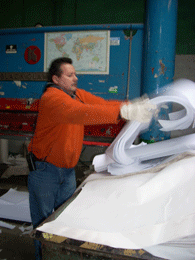
Luis Arorcho, the plant manager for the North Shore recycling plant for the past 28 years, cuts and stacks office paper to be recycled. (Photo: Christine Parrish)
POWELL: Do you know presently that it costs more money to drive a truckload of recyclables across Los Angeles than it costs to put it on a ship in Los Angles harbor and then unload it in Hong Kong. It’s cheaper to go across the ocean than it is across the city.
PARRISH: That has left cities and towns across the U.S. awash in a sea of recyclables. When prices for recycled goods were high, they could recycle trash into cash. Now, with the demand so low, many municipalities have to pay to have it hauled away.
BELING: The dynamics and the economics have changed based on the markets collapsing.
PARRISH: Christine Beling is a project engineer who works on recycling issues in New England for the Environmental Protection Agency.
BELING: In economic downtimes we don’t generate as much garbage, so we don’t generate as much garbage, we don’t generate as much recycling. The trucks go down the streets with less material in them, so it really changes the whole dynamic and the cost structure.
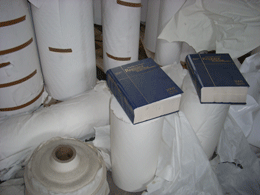
The market for high quality office paper and book leaf paper has not been hit as hard by the recession as lower quality paper products. Ends of rolls and books are recycled back into office paper. (Photo: Christine Parrish)
Jerry Powell of Resource Recycling Magazine says dumping recyclables into landfills hasn’t become a national problem, yet.
POWELL: I am more concerned about what will happen in six months if this deadbeat sort of recycling market continues.
PARRISH: Powell expects a recovery—but not without casualties. Several recycling companies around the country have gone bankrupt, as have some of the world's largest producers of newsprint and cardboard.
[SOUNDS OF RECYCLING LOT]
PARRISH: Third generation recycler Johnny Gold has weathered bad markets before, but nothing like this.
GOLD: [sigh] Well, you need cash. You’re starting every day on a negative and by the end of the day you’re still in a negative if you can’t get the prices up. It makes it extremely stressful. Every day it is another fire that we’re putting out.
PARRISH: Still, as he stands in the lot behind the North Shore Recycling plant where bales of cardboard continue to grow into towers, Johnny Gold remains optimistic. Recycling goes in cycles, he says, we’re just at the bottom of the curve.
GOLD: And we’ll get through it. You have to believe in this industry. I do. I think everybody’s in it. You have to believe in our country. We’ve hit other bricks before. We’ll get through it, but it’s been tough. Real tough.
PARRISH: For Living on Earth, I’m Christine Parrish in Salem, Massachusetts.
[MUSIC: Bill Laswell “Cybotron” from Dub Chamber 3 (Universal-Polygram 2000)]
CURWOOD: You can hear our program anytime on our website, or get a download for your mp3 player. The address is loe.org. That’s L-O-E dot O-R-G. There, you’ll also find pictures and more information about our stories. And we’d like to hear from you. You can reach us at comments@loe.org. Once again, comments-at-L-O-E dot O-R-G. Our postal address is 20 Holland Street, Somerville, Massachusetts, 02144. And you can call our listener line anytime at 800-218-9988. That’s 800-218-9988.
Living on Earth wants to hear from you!
Living on Earth
62 Calef Highway, Suite 212
Lee, NH 03861
Telephone: 617-287-4121
E-mail: comments@loe.org
Newsletter [Click here]
Donate to Living on Earth!
Living on Earth is an independent media program and relies entirely on contributions from listeners and institutions supporting public service. Please donate now to preserve an independent environmental voice.
NewsletterLiving on Earth offers a weekly delivery of the show's rundown to your mailbox. Sign up for our newsletter today!
 Sailors For The Sea: Be the change you want to sea.
 The Grantham Foundation for the Protection of the Environment: Committed to protecting and improving the health of the global environment.
 Contribute to Living on Earth and receive, as our gift to you, an archival print of one of Mark Seth Lender's extraordinary wildlife photographs. Follow the link to see Mark's current collection of photographs.
 Buy a signed copy of Mark Seth Lender's book Smeagull the Seagull & support Living on Earth
© Copyright World Media Foundation. All Rights Reserved
Home | Contact | RSS | Donate | Newsletter