

Katrina's Carbon Cost
Air Date: Week of January 4, 2008
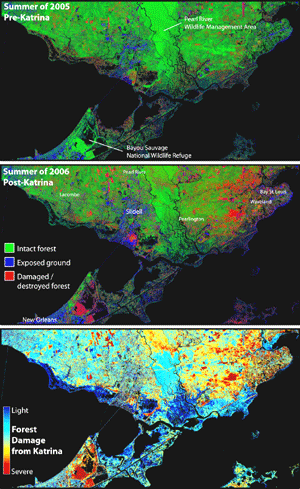
Hurricane Katrina’s landfall, before and after. Some of the most severe forest damages from Katrina occurred along the Pearl River on the border of Louisiana and Mississippi. Above, intact forests appear green before the hurricane. The summer after the hurricane, damaged and destroyed forests (in red) dominate the landscape. (Photo: Jeremy Fisher)
When Hurricane Katrina hit, the destruction stretched beyond human loss and property destruction. The environment suffered too. 320 million trees were lost and according scientists studying the issue, that’s having a huge impact on the region’s ability to absorb CO2 from the atmosphere, and may contribute to more storms like Katrina in the future.
Transcript
CURWOOD: It’s Living on Earth, I’m Steve Curwood. Trees can affect the climate and there’s an important case study for climate scientists in North America – the aftermath of Hurricane Katrina.
Three hundred and twenty million trees were destroyed due to that monster storm on the Gulf Coast. Climate scientists like Jeremy Fisher are just starting to quantify what effect that will have on weather and the amount of CO2 in the atmosphere.
Dr. Fisher works at Synapse Energy in Cambridge Mass, and co-authored a study with researchers at Tulane University on Hurricane Katrina’s Carbon Footprint. I recently asked him just how much carbon there is in 320 million trees.
FISHER: In 320 million trees there’s about 400 million tons of carbon. By our estimation, that’s about the same amount that the entire U.S. is able to draw down in photosynthesis every year.
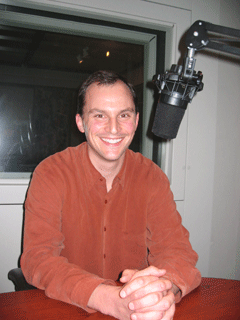
Jeremy Fisher in the Living on Earth studio.
(Photo: Ashley Ahearn)
FISHER: Sure. Well the average coal-fired power plant—a 500-megawatt unit—emits about 4 million tons of carbon dioxide every year. So if you can imagine, this would be about 100 of those plants.
CURWOOD: What killed those trees. Was it the wind? Was it the surge of saltwater?
FISHER: There were two different things that were going on at the same time. There was obviously the wind and that’s where we see the majority of the death happening inland. We saw a lot of trees that were snapping. And closer to the shore, we saw a lot of areas that had storm surge patterns. And so those are areas where, yeah, large waves are breaking over forests and even areas that were flooded for a significant amount of time were then inundated and died.
Hurricane Katrina’s landfall, before and after. Some of the most severe forest damages from Katrina occurred along the Pearl River on the border of Louisiana and Mississippi. Above, intact forests appear green before the hurricane. The summer after the hurricane, damaged and destroyed forests (in red) dominate the landscape. (Photo: Jeremy Fisher)
FISHER: One of my coauthors took a look at this recently and came up with the estimation that approximately one tenth the amount of carbon was released in the wildfires as Katrina—meaning that Katrina had a much, much larger footprint than these fires. That’s due to a number of factors. The forests out in California are much less dense than the forests in Louisiana.
But it’s important to note that the fires out in California also released the carbon dioxide immediately—the forests were burned. Whereas the forests in Louisiana are going to continue to decompose for the next 20 to 30 years.
CURWOOD: Now, sometime after Katrina, where these trees went down, there was so-called ‘salvage logging.’ People cut the dead and dying trees and hauled out some of the timber. How helpful or harmful is that to forest ecology?
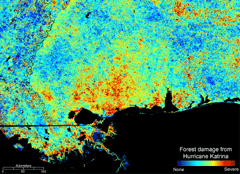
This analysis from a NASA satellite shows the footprint from Katrina over the regions forests. While much of the damage close to the coastline is due to storm surge, most of the image shows wind damage in natural and plantation forests.
(Photo: Jeremy Fisher)
CURWOOD: So what can your research tell us about the way we should manage land better in the future, perhaps to cope with Katrina-like storms?
FISHER: One of the interesting things that came out of this research is we found that a lot of mortality, a lot of the areas that had gotten hit most dramatically, were pine forests. We found that a lot of managed forests, a lot of plantation pines, had been wiped out by the wind. And so potentially we could imagine that we have some lessons to be learned for how we grow forests in the Gulf Coast, based off of the likelihood that a hurricane will blow through.
CURWOOD: So plantations are more vulnerable to Katrina-like storms is what I’m hearing?
FISHER: That’s what we found.
CURWOOD: Now, we know that forests help make weather. I mean, aside from sequestering carbon in their leaves and such, they are part of the whole water cycle. So, how might the weather have changed in this area where all these trees were lost from Katrina? And how might that then affect the ability of the forests to regenerate itself?
FISHER: There are some studies which have indicated that when forests are lost in general it changes the microclimate of a region such that it starts to experience droughts. I would expect that this area has been hit often enough by hurricanes that at least the natural ecosystems are able to bounce back on a fairly regular basis and that should not be as much of a problem, except for the invasive species that we were referring to earlier.
In general, this whole cycle of hurricane hitting forests and flattening trees, which release carbon, sets up a potential positive feedback cycle, in which carbon dioxide is released from those trees, goes into the atmosphere, will make global warming just a little bit worse, which we anticipate will increase the number of hurricanes, which then flatten more trees, releasing more carbon, and that causes a positive feedback cycle.
CURWOOD: To what extent do you think we’re in that cycle?
FISHER: It’s hard to know. We’re certainly heading towards that direction with the state of emissions where they are right now. The current climate models do anticipate that we are going to increase the number of hurricanes.
CURWOOD: Jeremy Fisher is a research associate with Synapse Energy in Cambridge Massachusetts. Thank you so much, Jeremy.
FISHER: Thank you, Steve.
Links
Living on Earth wants to hear from you!
Living on Earth
62 Calef Highway, Suite 212
Lee, NH 03861
Telephone: 617-287-4121
E-mail: comments@loe.org
Newsletter [Click here]
Donate to Living on Earth!
Living on Earth is an independent media program and relies entirely on contributions from listeners and institutions supporting public service. Please donate now to preserve an independent environmental voice.
NewsletterLiving on Earth offers a weekly delivery of the show's rundown to your mailbox. Sign up for our newsletter today!
 Sailors For The Sea: Be the change you want to sea.
 The Grantham Foundation for the Protection of the Environment: Committed to protecting and improving the health of the global environment.
 Contribute to Living on Earth and receive, as our gift to you, an archival print of one of Mark Seth Lender's extraordinary wildlife photographs. Follow the link to see Mark's current collection of photographs.
 Buy a signed copy of Mark Seth Lender's book Smeagull the Seagull & support Living on Earth
© Copyright World Media Foundation. All Rights Reserved
Home | Contact | RSS | Donate | Newsletter