

Don’t Bug Out
Air Date: Week of October 20, 2006
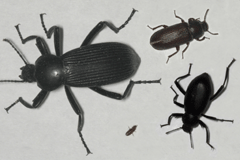
The beetles investigated in the study. From large to small: Eleodes obscura,Eleodes armata Tenebrio molitor,Tribolium castaneum (Photo: Alexander Kaiser)
Enormous insects swarmed the planet in the Paleozoic Era. Why did those bugs get so big while today’s do not? We hear from Jon Harrison, a scientist who says he has the answer, and says giant bugs will probably stay in the realm of science fiction in the future.
Transcript
YOUNG: Now we turn from little bugs to big bugs. Really big. Bugs with a two-foot wingspan. Some 300 million years ago, some insects were like that—gigantic. That we know from the fossil record. What we did not know is why those prehistoric bugs got so big and why today’s bugs, fortunately, do not.
Well, researchers from Arizona State and Midwestern Universities and the Argonne National Laboratory now think they know why. Arizona State biology professor Jon Harrison was the lead investigator. Welcome, Dr. Harrison.
HARRISON: Greetings, Jeff.
YOUNG: Tell me, what did you learn about why insects in prehistoric periods got so big?
HARRISON: Well, the link back to prehistoric time comes from work by Bob Burner (???) and others that showed that in the late Paleozoic, atmospheric oxygen was much higher than today, somewhere in the range of 30 percent oxygen. So, what we think the current working model is that you can get a larger insect with smaller trachea if the oxygen is high.
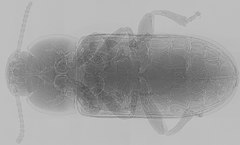
A tiled x-ray image of Tenebrio molitor. The lighter bands within the beetle are the tracheal tubes. (Photo: Alexander Kaiser and Jaco Klok.)
HARRISON: Yeah, so insects have a series of little holes along their bodies called spiracles. And then there are tubes, tiny tubes, that branch throughout their body. And the oxygen actually comes down, as a gas, right down to each tissue.
YOUNG: So, in ancient times we had 35 percent oxygen in the atmosphere?
HARRISON: Somewhere in that range.
YOUNG: And what is it today?
HARRISON: Twenty-one percent.
YOUNG: Aha. So, more oxygen in the atmosphere means the trachea didn’t have to be as big, right?
HARRISON: Exactly.
YOUNG: Well, how big can a bug get then?
HARRISON: Well, we certainly know from the fossil record that they could get up to 10 times bigger than they are today. Which, I mean a cockroach the size of your thigh would impress most people and would be considered maybe not quite like them, but a pretty scary sight.
YOUNG: And this works the other way around. Lower oxygen for at least some of these species you studied yielded smaller insects.
The beetles investigated in the study. From large to small:Eleodes obscura, Eleodes armata, Tenebrio molitor, Tribolium castaneum (Photo: Alexander Kaiser)
YOUNG: And our atmospheric concentration of oxygen has gone down a lot since 300 million years ago. Is it expected to continue to decline in the future?
HARRISON: We wish we knew. I mean it’s been constant for quite a while. So the balance between photosynthesis and respiration at the planetary level has been matched for a long time. I think it’s very interesting to look back and realize that there were periods of time where that was not the case.
YOUNG: Clearly, we’re in the realm of the hypothetical here, but if we had really big bugs, would there be big implications for the ecosystem?
HARRISON: Yeah, that’s a really fascinating question. I mean, of course, they are such great competitors that, one, I mean it’s hard to believe they wouldn’t have a tremendous effect on the ecosystem if they did get much larger. On the other hand, back when there were giant insects there weren’t birds and mammals around to eat them. So it’s not really clear who would come out on top. I’d like to hope it would be us.
YOUNG: Well, this is really kind of a fascinating topic, and I thank you very much for taking time to explain a little bit of it for us. Dr. John Harrison is a professor at Arizona State University. Dr. Harrison, thanks very much.
HARRISON: Thank you.
Links
Living on Earth wants to hear from you!
Living on Earth
62 Calef Highway, Suite 212
Lee, NH 03861
Telephone: 617-287-4121
E-mail: comments@loe.org
Newsletter [Click here]
Donate to Living on Earth!
Living on Earth is an independent media program and relies entirely on contributions from listeners and institutions supporting public service. Please donate now to preserve an independent environmental voice.
NewsletterLiving on Earth offers a weekly delivery of the show's rundown to your mailbox. Sign up for our newsletter today!
 Sailors For The Sea: Be the change you want to sea.
 The Grantham Foundation for the Protection of the Environment: Committed to protecting and improving the health of the global environment.
 Contribute to Living on Earth and receive, as our gift to you, an archival print of one of Mark Seth Lender's extraordinary wildlife photographs. Follow the link to see Mark's current collection of photographs.
 Buy a signed copy of Mark Seth Lender's book Smeagull the Seagull & support Living on Earth
© Copyright World Media Foundation. All Rights Reserved
Home | Contact | RSS | Donate | Newsletter