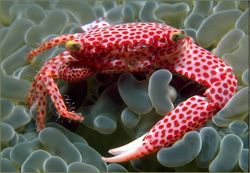
A Coral Crab. (Photo: Jeffrey N. Jeffords - Divegallery)
A Coral Crab. (Photo: Jeffrey N. Jeffords - Divegallery)
Researchers discover that crustaceans are able to detect and respond to the sounds of the coral reef. The study highlights how important ocean acoustics are to sea creatures, and how noise pollution from our ships could have a major impact on marine ecosystems. Sean Faulk reports.
GELLERMAN: Coming up: a visit to one of the world's most extreme deserts - but first this note on emerging science from Sean Faulk.
[SOUNDS OF A CORAL REEF]
FAULK: A coral reef is a noisy place, filled with sounds of clicking fish and snapping shrimp. That's important for reef-dwelling fish who head towards the noise to find their way back home.
[SCIENCE NOTE THEME]
A Coral Crab. (Photo: Jeffrey N. Jeffords - Divegallery)
FAULK: Now, researchers at Bristol University in the UK think reef noise is also important for crustaceans like shrimp, crabs, and lobsters - creatures previously thought to be deaf. Marine biologists collected almost 700,000 crustaceans from the Great Barrier Reef and put them into a large pool. They set up an underwater sound system that streamed a recording of a coral reef and what they saw surprised them.
Crustaceans like crabs and lobsters that live in reefs scuttled towards the noise, while others, those that eat plankton and have predators in reefs, scurried away. The scientists say their study highlights how important ocean acoustics are to sea creatures and how noise pollution from our ships could disrupt marine ecosystems.
A recent study showed that in the last 50 years, man-made noise in the ocean has increased a hundredfold. If we continue at that rate, our industrial noises may drown out the chirps and snaps that make up the chorus of the coral reef.
[SOUND OF THE CORAL REEF]
FAULK: That's this week's Note on Emerging Science, I'm Sean Faulk.
[SCIENCE NOTE THEME]