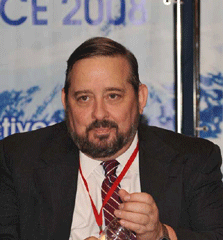
Professor Chuck Kennicutt.
Warming ocean currents could force Emperor penguins to swim farther for food. (Photo: Samuel Blanc)
Representatives of more than 60 nations and international organizations are meeting in Baltimore to discuss the state of Earth's melting polar regions. Living on Earth host Steve Curwood talks with Chuck Kennicutt, president of the Scientific Committee on Antarctic Research, about some of the science that's driving the discussions-- from warming ocean currents to the struggles of Emperor penguins.
CURWOOD: It’s Living on Earth, I’m Steve Curwood.
The latest round of talks leading up to an updated UN climate change treaty wound up April 8 in Bonn, Germany with the US pledging to work hard in the effort to reach consensus by year’s end in Copenhagen. And even as delegates met, an ice bridge gave way in Antarctica, the tenth such major ice collapse in recent times. US Secretary of State Hillary Clinton was quick to link the climate talks to the agenda of the first ever meeting of the Arctic Council and Antarctic Treaty nations that she hosted in Baltimore.
CLINTON: Climate change is shaping the future of our planet in ways we are still striving to understand. And with the collapse of an ice bridge that holds in place the Wilkins Ice Shelf, we are reminded that global warming has already had enormous effects on our planet, and we have no time to lose in tackling this crisis.
CURWOOD: Chuck Kennicutt is president of the Scientific Committee on Antarctic Research, a professor of oceanography at Texas A&M University, and a delegate to the polar conference.
Professor Kennicutt, what can you tell us about the science that’s on the agenda?
Professor Chuck Kennicutt.
CURWOOD: Talk to me about the West Antarctic Ice Sheet, we’re told that forecasts say that if this ice sheet, which I gather is kind of hard aground, if it were to melt enough, or the stuff underneath it were to melt enough and it were to slide into the ocean, this would raise sea level around the planet. Are we getting data that there are changes happening there?
KENNICUTT: Yes, in fact, that’s one of the big unknowns, contrasting what is occurring in the north with what’s occurring in the south. In the north, because sea ice is already floating, that means that it’s already part of the current sea level. In the south, though, most of the ice is grounded, it’s actually sitting up on land, it’s not in the ocean. And so as that ice melts, though, that actually raises sea level, which raises the level worldwide. That’s why it’s a worldwide impact.
CURWOOD: How much sea level rise are we talking about?
KENNICUTT: Well, West Antarctica could be as much as sixty feet of sea level, which is really quite spectacular. But, that’s if everything melted, and that’s very unlikely. Just so people understand, an ice shelf is the seaward extension of an ice sheet. And the ice sheet being grounded on land where it’s actually sitting on a solid rock base, whereas the ice shelf actually flows out over a bay. So it’s floating ice. Probably the greatest concern, though, is that the disintegration of these ice shelves then allow the ice sheets to move even faster. In other words, the seaward extension of the ice was actually holding back the land based ice. And this has come from actual observations, because a number of these ice shelves have disintegrated over the last ten years or so.
CURWOOD: You say that some of the recent research presented at your meeting talks about the changing ocean currents. How are they changing and how important is this?
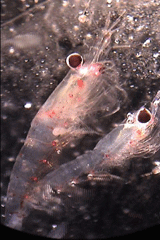
Krill are key to the Antarctic ecosystem.(Photo: NOAA)
CURWOOD: Now, we also hear that some of the ecosystems there are under stress. I gather there’s been some talk at this conference about the change in the amount of krill – the Antarctic krill – in the region. What do we know about that?
KENNICUTT: Now many polar organisms, including krill, because they’ve evolved in these types of environments, their lifecycles are tied very closely to the presence or absence of ice. Now the krill, particularly in the southern ocean system, is what’s referred to as a keystone species. That means it’s very critical to the overall food web. So penguins feed extensively on krill, the whales feed on krill – so you have a ripple effect.
CURWOOD: What about the Emperor penguins? A lot of people know about them after the famous movie.
KENNICUTTT: Yes. There was an interesting study just lately that again showed that the current warming was having rather dramatic effects on their habitat and started to raise questions of in the next several decades if they are not going to start to have some detrimental effects due to loss of habitat. And again, this is loss of ice and loss of food stuffs.
CURWOOD: In other words, the penguins could march all the way back to the sea to get fed, but there wouldn’t be anything to eat?
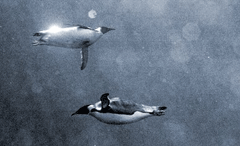
Warming ocean currents could force Emperor penguins to swim farther for food. (Photo: Samuel Blanc)
CURWOOD: Chuck Kennicutt is the president of the Scientific Committee on Antarctic Research, and a professor at Texas A&M. Thank you so much, Professor.
KENNICUTT: Okay, appreciate it.
Links http://classic.ipy.org/start//index.php - Check out the scientific collaborations of International Polar Year http://www.pewclimate.org/arctic-antarctic-impacts - Learn more about how global warming is impacting the Polar regions http://oceanz.tamu.edu/Directory/Faculty/Chem/kennicutt.html - For more on Chuck Kennicutt, click here http://www.scar.org/ - Link to the Scientific Committee on Antarctic Research’s website