

Lady Mary Pierrepont Wortely Montagu
Published: February 6, 2018
(stream/download) as an MP3 file
 | |
|
|
Women of Discovery: Lady Mary Pierrepont Wortely Montagu


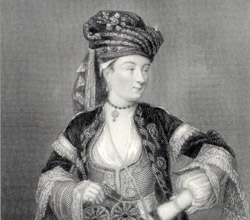
 When her husband was sent to Constantinople on government service, Lady Montagu took the unusual step of going with him. Though they only traveled for a few years, she came home with an expanded vision of the world. She also came home with an expanded understanding of the world of medicine; in Turkey, she learned about a form of vaccination in which the smallpox virus was introduced through the skin to protect healthy patients. Vaccination had yet to be discovered by western medicine, and smallpox in England was killing one in four people during the worst parts of the epidemic of 1721.
| Listen to Montagu's exotic and startling first experience in a Turkish bath house |
Lady Montagu herself had already contracted smallpox before visiting Turkey. The disease marred her beautiful face, but she was one of the lucky ones. After her return, more than a dozen of her acquaintances died in this latest epidemic, and fearing for her daughter’s life, she insisted that her doctor inoculate the young girl.
Because smallpox was claiming so many lives, news of the use of inoculation spread throughout England and across the Atlantic to Boston, where a similar epidemic was rapidly spreading. City fathers in Boston immediately outlawed the use of inoculation. The debate raged in London, with newspapers and pamphlets variously depicting inoculation supporters as gambling with their children’s lives, or providing them with needed medical care, depending on which side the writers took. Some writers against inoculation suggested that the practice was weakening human dependence on God, that it was unscientific and dangerous, or that it resulted from unwanted Turkish or female influence. Nevertheless, many people inoculated themselves and their children.
Lady Montagu spread the word as well as she could, including writing a scathing critique of the medical profession for not doing enough to protect their patients’ health, while doing too much to protect their own income and prestige.
|
| | ||||
| ||||||
| ||||||
| ||||||
 |
Back to Women of Discovery
Living on Earth wants to hear from you!
Living on Earth
62 Calef Highway, Suite 212
Lee, NH 03861
Telephone: 617-287-4121
E-mail: comments@loe.org
Newsletter [Click here]
Donate to Living on Earth!
Living on Earth is an independent media program and relies entirely on contributions from listeners and institutions supporting public service. Please donate now to preserve an independent environmental voice.
NewsletterLiving on Earth offers a weekly delivery of the show's rundown to your mailbox. Sign up for our newsletter today!
 Sailors For The Sea: Be the change you want to sea.
 The Grantham Foundation for the Protection of the Environment: Committed to protecting and improving the health of the global environment.
 Contribute to Living on Earth and receive, as our gift to you, an archival print of one of Mark Seth Lender's extraordinary wildlife photographs. Follow the link to see Mark's current collection of photographs.
 Buy a signed copy of Mark Seth Lender's book Smeagull the Seagull & support Living on Earth
© Copyright World Media Foundation. All Rights Reserved
Home | Contact | RSS | Donate | Newsletter