

Antarctic Check-Up
Air Date: Week of April 12, 1996
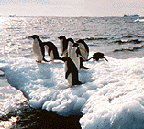
Adelie penguins at Cape Byrd. New Zealand researchers are studying the Antarctic food chain to find out why thousands of penguin chicks have starved to death in recent years.
Untouched by humans for millions of years, the frozen south is now an important outpost for studying human impact on the planet. In the first of a four part series, Terry FitzPatrick reports how greenhouse gases, ozone depletion, and surging tourism are affecting the fragile continent.
Transcript
CURWOOD: This is Living On Earth. I'm Steve Curwood. It is hard to imagine life thriving on the world's coldest continent. Antarctica is covered with ice and holds the world record for the lowest temperature ever recorded: 129 degrees Fahrenheit below zero.
But untouched by humans for millions of years, parts of Antarctica are home to a fragile ecosystem. And in the past few years, it's become one of the world's most important outposts to study the far-reaching effects of human civilization. And the ozone hole, climate change--even tourism--are all taking a toll on Antarctica's web of life.
This week we begin a four-part series of special reports by Living on Earth's Terry FitzPatrick, who visited Antarctica early this year.
(Walking on snow, ice axes probe snow)
FITZPATRICK: Traveling to the edge of the Ross Ice Shelf is like traveling to the ends of the earth. This is the southernmost stretch of ocean in the world, so close to the frigid South Pole that much of the sea is draped by a floating blanket of ice.
(Ice probe)
ROBINSON: As far as the ice edge, don't go too close because the water comes and it wears it out underneath so it's like a ledge and it looks solid but it's only a couple inches thick.
FITZPATRICK: Navy pilot Greg Robinson probes for weak spots with a mountaineering ice ax...and I carefully follow his footsteps.
(Probing ice)
FITZPATRICK: We're headed to see one of Antarctica's most magnificent residents: the killer whale.
(Waves lapping against the ice edge)
ROBINSON: You just kind of make some noise. (Tape ice ax) They're curious animals, they'll come over and check it out.
FITZPATRICK: The scenery here is breathtaking. Huge icebergs floating in the open water. A snow-covered volcano on the horizon--with steam rising from its summit. In a matter of minutes, our noise-making works.
(whale breath)
FITZPATRICK: Four killer whales. So close we can hear them breathe. One whale pokes its head above water just ten feet away.
ROBINSON: They're just out here cruising around these different slots here looking for something to eat and they hear noise. They want to see what it is.FITZPATRICK: They're not afraid of people though?
ROBINSON: No not at all. Just about everything down here has no fear of man at all.
(whale breath)
FITZPATRICK: Whales and seals were once close to extinction here, hunted throughout the oceans that encircle the Antarctic mainland. But international treaties have transformed the entire continent into the world's largest wildlife sanctuary. It's a unique laboratory to study how life survives in such hostile conditions.
(scuba gear equipment rustling)
FITZPATRICK: Most of Antarctica's wildlife lives at sea, not on land. So marine biologists must sometimes dive beneath the ice.
(Air tank)
FITZPATRICK: Rikk Kvitek, from the Moss Landing Marine Laboratory in California, is preparing to videotape giant sponges and worms that thrive on the sea floor.
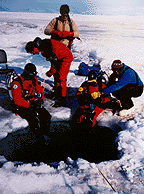
Ice divers from California'sMoss Landing Marine Lab and the Canadian Museum of Nature prepare to study the wealth of underwater creatures that thrive in the Ross Sea, the southernmost ocean on earth
FITZPATRICK: Is it dark down there?KVITEK: The light is muted because you've got--what--ten feet of ice with snow over the top of it and so not a lot of light is getting down through the ice, but your eyes adjust to it. It's sort of like--if you could imagine floating over a desert with a full moon--(edit) the sponges are sticking up kind of like cactus. And the ice overhead is sort of like clouds. And the hole is sort of like the moon. The hole is sort of a spotlight shining down on you.
(zipping suit, squeaky gloves)
FITZPATRICK: Gearing-up for an Antarctic dive is a bit like preparing for a spacewalk. A heavy rubber suit will keep Dr. Kvitek warm. It's just 28 degrees down below--the freezing point for salt water. Ropes will tether him to the surface. A special mask will allow him to speak throughout the dive.
(Testing the mask "okay.")
FITZPATRICK: These researchers are investigating what happens when six months of winter darkness give way to round-the-clock sunshine during summer. Kathy Conlan is with the Canadian Museum of Nature.
(water splashing)
CONLAN: That period when it comes on to 24-hour sunlight is a huge boom time and it lasts for a couple of months and then it goes down to a bust for the rest of the year. And that's when the animals out there are reproducing like mad. They're eating like mad, and their offspring are getting as big as possible before it goes down to bust conditions again.
(Dive-in splash, breathing in regulators)
FITZPATRICK: Two divers will spend half an hour at a depth of 100 feet.
(bubbles)
FITZPATRICK: Through his underwater mask, Dr. Kvitek reports his progress.
KVITEK (on mask): We can see the under-ice now. Big pockets of air, some of them are big enough you can stick your head up into and breathe. When the divers reach bottom they'll encounter a vibrant jungle of shapes and colors.CONLAN: There's quite an elevation difference because the large sponges can be several feet tall. And then the tunicates are bright orange and they look rather like big pumpkins with two vase openings which they will close in when you get close to them. And then there's soft corals. The large soft corals look like trees, they're orange. And then there's smaller ones that look like little snowflakes that dot the bottom.
FITZPATRICK: As Dr. Kvitek begins his underwater photography, he's joined by creatures who're attracted to the lights.
KVITEK (on mask): Bright yellow, bright white. Pink stars, purple worms. The color is really amazing down here when you put a little bit of light on it.
FITZPATRICK: The videotapes will allow Dr. Kvitek to analyze the sea-floor even after his dive is over. He'll also collect specimens to examine in the lab.
(Lab door opens, lab background noise, crowd in lab)
FITZPATRICK: This is McMurdo Station--America's research headquarters. With more than a hundred buildings and a thousand personnel, it's the largest outpost on the continent.
(lab door slams, burgling aquarium)
FITZPATRICK: Inside the lab, pumps bring sea water into the McMurdo aquarium.
MANAHAN: Have you put your hand in there yet? Try it out.FITZPATRICK: No.
MANAHAN: Okay.
(Water splash sweetening)
FITZPATRICK: That's pretty cold.MANAHAN: You betcha.
FITZPATRICK: Donal Manahan, from the University of Southern California, is studying ingenious adaptations life develops to survive and reproduce in water this cold. Fish, for example, have organic anti-freeze in their blood. Bacteria have found ways to sustain biochemical reactions at lower temperatures than normal.
MANAHAN: You put your hand in that water and you wonder how anything can live in it. It is so painful to a human hand to put it into Antarctic sea water. And yet when you look under the ice here, it is one of the most abundant environments on earth.
FITZPATRICK: However, fish and wildlife now encounter conditions that nature never intended. Global warming is causing ice sheets to crumble and lake levels to rise--which alters habitat for a wide range of species. As well, the entire continent is subjected each spring to the ozone hole.
(Lab ambience shift)
KARENZ: Okay, there they are. They're swimming around. And they look very happy. (laughs)
FITZPATRICK: Deneb Karenz from the University of San Francisco is measuring how baby sea urchins are coping with the effects of ozone depletion. The earth's ozone layer normally blocks the sun's deadly ultraviolet rays. But industrial pollution now creates a huge ozone hole each year above Antarctica. As a result, U-V exposure jumps by 50 to 100 percent. Millions of microscopic plants and animals are exposed to a potentially lethal sunburn.
(buzz of microscope, crinkling plastic bag with urchins inside)
FITZPATRICK: Beneath the microscope, you can see why baby sea urchins are vulnerable. They're nearly transparent, like jellyfish.
FITZPATRICK (In the lab): They're incredible. It's really interesting to watch life this new.
(Lab ambience)
FITZPATRICK: The DNA in organisms like these is poorly protected and can easily be damaged by ultraviolet radiation. Baby sea urchins aren't the only victims. Worst hit are phytoplankton, the tiny plants that comprise the base of the food chain. Scientists have detected a 15-percent drop in photosynthesis when plankton cells are hit by increased UV light. Researchers like Dr. Karenz don't know exactly what the consequences of this may be. The ozone hole is a relatively new phenomenon, first discovered in 1985.
KARENZ: We have no baseline data. There's no UV work done here prior to the ozone hole. We come down after the ozone hole has already been around for a decade, and so what we're looking at now is already an altered system. And so it's very difficult to make any kind of assessment.
FITZPATRICK: However, a decrease in plankton could create a food shortage that might ripple up the food chain to larger species--like penguins.
(Penguin outburst)
FITZPATRICK: The rocky beach of Cape Byrd is home to more than 50-thousand Adelie penguins. There's never a dull moment here. Chicks relentlessly chirp for a meal of regurgitated seafood.
(Chick sounds)
FITZPATRICK: Adelie penguins are characters. Kerry Barton of New Zealand's Antarctic Research Program never knows how they'll react.
(wide ambience of colony)
BARTON: Some of them are quite aggressive and they rush up and flip and bash you around the legs. Other ones just ignore you or come up and gently wave their arms backwards and forwards at you trying to identify what you are. And other ones take off, terrified, and rush around in circles for a while and then decide you're all right and give up.
FITZPATRICK: In the past two years, penguins have been the subject of disturbing news. Australian researchers discovered the mass starvation of Adelie chicks in three separate regions of Antarctica last year. Their parents were unable to find any food within 100 miles of shore. Now--says New Zealand researcher Brian Karl--some chicks are struggling to survive here at Cape Byrd.
KARL: This year they're not doing too well at all, seemingly. They're late, the chicks are not at the same stage as what they have been at previous years.
(netting bird sound, rookery background sounds)
FITZPATRICK: To find out why, New Zealand researchers are netting 80 penguins for an unusual scientific procedure.
(Squawking penguin)
FITZPATRICK: They're draining the food from penguin stomachs to see exactly what the birds are eating. A plastic tube is slipped down the penguin's throat and researchers massage its belly as they turn the bird upside down.
KARL: And we wait for the bird to sick up into the bucket.
FITZPATRICK: The ordeal is disorienting for the penguin...but it's certainly better than killing the bird, which is what researchers used to do to examine stomach contents. Now the penguin is back to normal within an hour.
(Penguin released, jostling the jars with the stomach samples, rookery background sounds)
FITZPATRICK: The stomach samples suggest this colony may be suffering from inadequate nutrition.
(Jostling jars)
FITZPATRICK: Instead of feasting on krill--a shrimp-like organism that's the mainstay of the penguin diet--the birds are relying mostly on fish.
KERRY: Would you like to try some?
FITZPATRICK: I'd like to smell it. (Smells) Whoof! The contents are heavily digested which indicates the penguins are swimming a long way to find dinner and are burning it up before getting home to regurgitate a meal for their chicks.
(More jostling of jars)
FITZPATRICK: Most alarming--says Kerry Barton--are specimens showing some penguins with nearly nothing inside their stomachs after a week at sea.
BARTON: And this is the entire sample the bird had in its stomach. It's probably only about two tablespoons of food. And this bird's been out doing serious fishing and that's all it's managed to come back with.
(Penguin ambience)
FITZPATRICK: The decline in penguin food supply raises serious questions. Is the ozone hole to blame? Is ultraviolet light damaging the marine food web? Or is global warming sweeping the food supply away by disrupting ocean currents? Or have commercial fishing fleets been too greedy in the southern oceans? Scientists just don't know. Die-offs might well be part of a natural cycle. It may be decades before they're sure.
(People milling sounds)
FITZPATRICK: Researchers have identified a different threat to Antarctic wildlife, however, that people definitely can control.
KENNEDY: Okay, well welcome everyone to McMurdo station...(speech under)
FITZPATRICK: It's opening day of tourist season. 100 passengers from a cruise ship have arrived at the U.S. base.
KENNEDY: Today as your guides, you will have some civilian station personnel and some military personnel that will give you a tour of our station. (speech under)
(People milling sounds)
FITZPATRICK:Tourism has exploded here in the past 15 years. Eight-thousand people now visit Antarctica's scientific bases and wildlife colonies every summer. For adventure travelers like Keri Gouge of Australia, it's a thrill they'll never forget.
GOUGE: We have seen penguins--more than you'd ever want to see in a lifetime, and seals, and some whales and obviously lots of birds as well. It's just been an amazing trip.
(People milling sounds)
KENNEDY: Group A, Group A, Nadine...
FITZPATRICK: Tourist groups have gotten so large that keeping them moving is like marshaling a parade.
KENNEDY: Let Group A know that we need them back down here by 10:30. Roger. It's like herding sheep (laughs).
FITZPATRICK: Nadine Kennedy is with the National Science Foundation--which runs the U.S. Antarctic program. She's happy to show tourists how American tax dollars are spent.
KENNEDY: We think of these people as Antarctic ambassadors. If we can just share a little bit of what we do down here, then they go back and they tell their friends about it.
(People milling sounds)
FITZPATRICK: Experts are concerned, though, that waves of tourists might overwhelm Antarctica's fragile environment. Even small groups of people can cause penguins to panic and abandon their young. And even the most careful tourist can trample delicate lichens and moss. That's why scientists fear the growing popularity of Antarctic expeditions. Colin Harris is with the International Committee for Antarctic Information and Research. He's investigating the cumulative impact of tourist visits.
HARRIS: Because there's a limited number of very suitable sites where landings can be made and there's good wildlife to be seen, the tourist ships often visit the same site as the previous one and the previous one to that. So some sites are actually getting two or three tourist ships a week.
(More milling tourist sound)
FITZPATRICK: Tourism is responsible for the two worst disasters in Antarctic history. In 1979 a sight-seeing jet crashed, killing 257 passengers. Then, in 1989, a ship spilled 150,000 gallons of fuel when it ran aground and sank while carrying tourists in a scenic bay. Since then, tour companies have taken steps to improve safety and minimize environmental damage. Dick Walker of Adventure Network International, says tourists don't mind the restrictions.
WALKER: I think most of the clients are very environmentally aware and probably wouldn't come if they thought there was going to be a huge negative impact.
(Tourist milling sound and ocean ambience)
FITZPATRICK: Tourists are now prohibited from visiting some sites in Antarctica--and rules are being developed to make tour companies liable for the costs of cleaning up any damage they cause. It's part of an international treaty that also bans mining and oil production here for the next 50 years. Despite the threats to Antarctica's penguins and whales--and even its microscopic plankton--this is still the least-spoiled place on the planet. There are fewer people on this vast continent than you'd find on a single block in Manhattan. It'll remain that way for the foreseeable future--because it's incredibly expensive to get here and even more costly to stay alive once you've arrived. Environmentalists point to the progress in regulating tourists and banning oil production as proof that the world recognizes the value of preserving this striking landscape. That makes Antarctica one of the world's great environmental success stories. The earth's most isolated continent will remain a place of natural wonder.
(Whale sounds)
For Living on Earth, this is Terry FitzPatrick reporting.
Living on Earth wants to hear from you!
Living on Earth
62 Calef Highway, Suite 212
Lee, NH 03861
Telephone: 617-287-4121
E-mail: comments@loe.org
Newsletter [Click here]
Donate to Living on Earth!
Living on Earth is an independent media program and relies entirely on contributions from listeners and institutions supporting public service. Please donate now to preserve an independent environmental voice.
NewsletterLiving on Earth offers a weekly delivery of the show's rundown to your mailbox. Sign up for our newsletter today!
 Sailors For The Sea: Be the change you want to sea.
 The Grantham Foundation for the Protection of the Environment: Committed to protecting and improving the health of the global environment.
 Contribute to Living on Earth and receive, as our gift to you, an archival print of one of Mark Seth Lender's extraordinary wildlife photographs. Follow the link to see Mark's current collection of photographs.
 Buy a signed copy of Mark Seth Lender's book Smeagull the Seagull & support Living on Earth
© Copyright World Media Foundation. All Rights Reserved
Home | Contact | RSS | Donate | Newsletter