

Antarctica Series: Part 4 - An Ice Journal
Air Date: Week of January 17, 1997
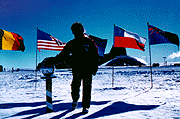
The South Pole. The bottom of the earth is marked by flags of the 12 nations that signed the Antarctic Treaty in 1959. The treaty suspends all claims of sovereignty, declaring the continent as international territory that is to be used only for peaceful scientific purposes.
In his final installment, reporter Terry FitzPatrick shares a personal audio journal of his experiences and impressions while traveling to Antarctica for Living on Earth on a National Science Foundation grant. Encore broadcast.
Transcript
CURWOOD: For the past few weeks Living on Earth's Terry FitzPatrick has been telling us about the glaciers and wildlife of Antarctica. But some of the most fascinating stories from his month-long journey to the continent involve the wild lives led by people who venture into one of the world's most challenging environments to conduct scientific research. Today we conclude our encore presentation of Terry's Antarctica series with his observations about what life is like for people who work at the bottom of the world.
FITZ PATRICK: Despite its romantic appeal, Antarctica can be an exhausting place. People here work flat out, cramming as much research as possible into the short polar summer. So it's little wonder that at the end of the season, folks let loose.
(People going, "Whoo!" Music in the background)
FITZ PATRICK: These researchers have used their engineering expertise to convert an ice drilling rig into a hot tub.
(People: "Whoo! It's hot!")
FITZ PATRICK: The wind chill is 15 degrees below zero. But that's nothing a warm soak and a little vodka can't conquer. People invited me to strip and join them.
(Voices: "Yeah!" "Are you serious about the Antarctic experience?" "You've got to live it." "Hey, take it off, Terry, take it off!" Laughter. "Terry. Terry...")
FITZ PATRICK: I wanted to hop in, but I was sick. And I was about to catch a plane to begin my trip back home. I tried to explain but folks didn't buy it.
(Voices: "Terry, you wimp! It's because you're a radio reporter; if you did television you'd have been in here!")
FITZ PATRICK: And so there I stood with bronchitis, bundled in my fur-trimmed parka, recording the revelry of a dozen nude Antarctic explorers.
(Voices: "Waterloo!" Singing along with a radio.)
FITZ PATRICK: I thought I'd seen everything but the best was yet to come.
(A motor runs)
FITZ PATRICK: As my plane arrived 2 plumes of steam came racing my way from the vicinity of the hot tub. A woman, naked, on a snowmobile, towing a man, naked, on skis. They circled the plane, hugged the pilot, and headed back to the party.
(The motor continues to run)
FITZ PATRICK: The hot tub drove home the work hard, play hard atmosphere in Antarctica. Research on the stability of the ice cap or the effects of the ozone hole can be stressful, involving difficult journeys to remote field locations. Wildly unpredictable weather can also make this a dangerous place. Fifty-six people have died on American expeditions since World War II. The dangers are emphasized the moment you arrive. Everyone who goes into the field must attend 2 days of survival training.
(Chains clank)
McCARTHY: All right! So everyone's got a harness, okay. Now the first thing you need, you're going to do, is...
FITZ PATRICK: Our teacher is back country guide Forrest McCarthy. He demonstrates the use of climbing harnesses and ropes, essential equipment for travel on the ice cap where crevasses can open up and swallow a person without warning.
McCARTHY: You've got to double back your harness. Now, see how I take this strap, and I double back through that buckle. Now people have died because they didn't do that.
(Chains clanking, footfalls on ice)
FITZ PATRICK: Roped up and underway on our first Antarctic day hike, we skirt the lip of an impressive crevasse.
(More footfalls)
McCARTHY: How are you doing?FITZ PATRICK: All right.
McCARTHY: Good.
(Wind whips)
FITZ PATRICK: Then we're lowered into the crevasse one by one, as fellow students practice the teamwork required for a rescue.
McCORMICK: The trick to surviving down here has a lot to do with attitude.
FITZ PATRICK: Instructor Bill McCormick says survival school is designed to instill a healthy regard for the elements.
McCORMICK: There is a lot of specific things to this environment. You have to start developing an eye for and a respect for -- the weather is, you know, maybe the major feature and most people don't have a sense of how ferocious it can be and how rapidly it can change.
(Metal against ice)
FITZ PATRICK: Sometimes the only way to escape life-threatening winds is to build an igloo, or dig an emergency trench. So Mr. McCormick shows us how.
McCORMICK: Basically it's like digging a grave for yourself, but this is the grave that saves; I just made that up right now. Never used that line before.FITZ PATRICK: Is that true?
McCORMICK: It's true. (Laughs)
(Sawing continues)
FITZ PATRICK: After a difficult day of training, I slept 4 miles from base camp in a shelter made of snow. Because nature can be so ferocious, people are required to stick close to camp when they're not conducting research. As a result there's always a touch of cabin fever in the air.
(People milling)
FITZ PATRICK: That's especially true at America's main research complex, McMurdo Station, where 1,200 people crowd into the cafeteria every day.
(More milling)
FITZ PATRICK: McMurdo is more like a town than a camp, and its personality is shaped by a curious blend of 3 distinct cultures. Scientists make it feel like a college campus. Pilots make it feel like a Navy base. Cooks, mechanics, and other support personnel make it feel like a frontier town.
(More milling)
FITZ PATRICK: The 3 groups rarely mix and sit apart during meals. About the only time they do sit together is in church. That's where assistant chaplain Simon Eckleton conducts Catholic mass beneath a stained glass image of a penguin. Father Eckleton says the peculiar conditions make McMurdo a difficult place to live.
ECKLETON: People have to have outlets, and there aren't the normal outlets that there would be back home. And the family from which so much stability grows is entirely lacking. There are no children here. There are no elderly people here. There are no sick people here. So we may call ourselves a community and a town, McMurdo, but the fact is it's a very strange environment, and the harshness of the climate really is reflected in the harshness of life within the community.
FITZ PATRICK: You can see this harshness in McMurdo's 2 taverns. Especially for the support personnel, this is a hard drinking town. The most popular entertainment is karaoke night in a dimly lit bar called The Southern Exposure.
(A man sings Johnny Cash: "I hear the train a'comin. It's rollin' round the bend. And I ain't seen the sunshine since I don't know when. I'm stuck in Folsom Prison, and time keeps draggin' on...")
FITZ PATRICK: The National Science Foundation, which runs the US Antarctic Program, is trying to curb the use of alcohol. Eric Chang, the senior US official here, has closed a number of bars in town.
CHANG: Not only were there 5 formal bars or clubs, you could find bars in all of the work centers. You know, under the excuse that you needed, that you might get trapped in a facility during a major storm. Alcohol was the recreational outlet, you know, years past.
FITZ PATRICK: Officials now promote other forms of recreation, including cross-country skiing, aerobics, even bowling.
(A bowling ball careens down a lane and hits pins. People go, "Oh!" and cheer.)
FITZ PATRICK: McMurdo is home to the world's southernmost bowling alley. Two lanes, with a manual pin setting. The bowling alley is where I met Shana Muldoon, a heavy equipment driver. Ms. Muldoon commends officials for trying to make McMurdo more livable.
MULDOON: When I first came down 3 years ago I thought about the basics. I was thinking, we're going to have only the basics and that's going to be it. I was shocked when we had VCRs and televisions and stuff like that. I was like, wow, I mean I was pleasantly surprised.
FITZ PATRICK: However, Ms. Muldoon did point out a different problem: the lack of women. There are 3 men here for every woman, which Ms. Muldoon told me can result in unwelcome come-ons.
MULDOON: Well, you just go into the bar and you're surrounded. Which like I said, it can be flattering, but then at other times it can be -- you don't trust them any more. You know that you're one of the few women so of course they're going to flatter you whether it's true or not.
FITZ PATRICK: Officials are trying to recruit more women, and in general are striving to transform McMurdo's social environment. With weekly movies, a coffee house, and satellite telephone service back to the States. Officials say healthy morale improves productivity and makes the base attractive enough for experienced personnel to want to return.
(Fans run)
FITZ PATRICK: The improvements go beyond creature comforts. The laboratories here are as good as you'd find at many American universities. Marine biologist Donald Mannahan from the University of Southern California appreciates how the infrastructure allows him to focus on his work.
MANNAHAN: It's one of the few towns on the planet Earth where science comes first. Not only that, it's multi-disciplinary. When you sit down at dinner here, one day you're sitting beside a biologist, the next day you're sitting by somebody studying the ozone hole, the next day it's a geologist. So this is a very interesting area for collaborative interdisciplinary science, which is really an important thing for future environmental studies is to put together the different disciplines.
FITZ PATRICK: These different kinds of scientists come to Antarctica because it's the most isolated and least studied continent on Earth. And despite efforts to make this place a bit more like home, the rugged conditions give it a special appeal for a certain type of individual. It instills a frontier spirit that's difficult to shake. That's evident in the saying support personnel have about Antarctica: the first year you come for the adventure; the second year you come for the money, and the third year you come because you don't fit in anyplace else. For Living on Earth, this is Terry FitzPatrick reporting.
Living on Earth wants to hear from you!
Living on Earth
62 Calef Highway, Suite 212
Lee, NH 03861
Telephone: 617-287-4121
E-mail: comments@loe.org
Newsletter [Click here]
Donate to Living on Earth!
Living on Earth is an independent media program and relies entirely on contributions from listeners and institutions supporting public service. Please donate now to preserve an independent environmental voice.
NewsletterLiving on Earth offers a weekly delivery of the show's rundown to your mailbox. Sign up for our newsletter today!
 Sailors For The Sea: Be the change you want to sea.
 The Grantham Foundation for the Protection of the Environment: Committed to protecting and improving the health of the global environment.
 Contribute to Living on Earth and receive, as our gift to you, an archival print of one of Mark Seth Lender's extraordinary wildlife photographs. Follow the link to see Mark's current collection of photographs.
 Buy a signed copy of Mark Seth Lender's book Smeagull the Seagull & support Living on Earth
© Copyright World Media Foundation. All Rights Reserved
Home | Contact | RSS | Donate | Newsletter